November 17, 2026
Pickleball Heat Safety: Hot Courts, Open Play and Long Summer Days
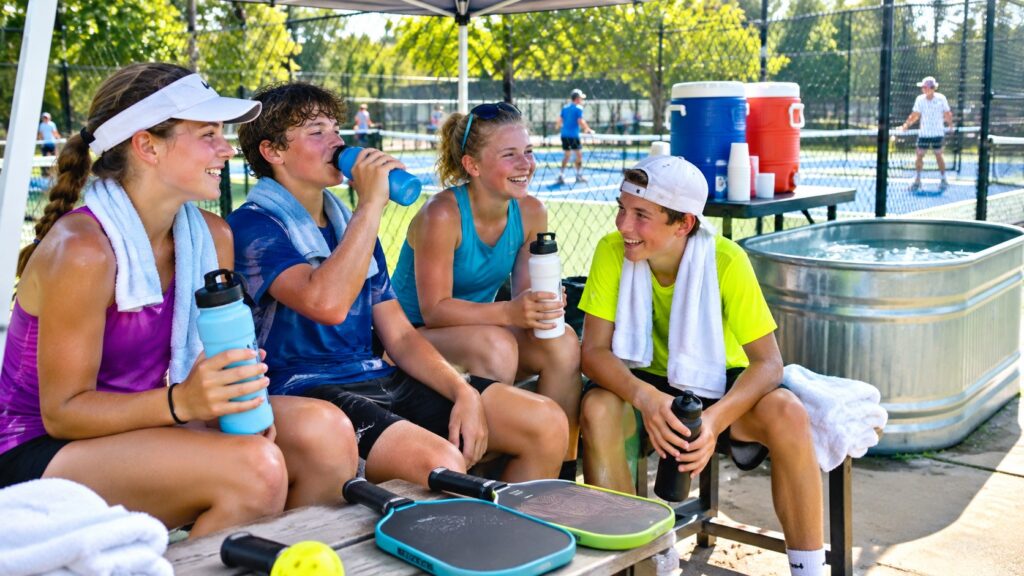
Pickleball is now part of PE classes, summer camps and park programs, and many young players spend long summer days on outdoor courts. The games are short, so the sport can look easy on the body. But outdoor courts are hard surfaces in full sun, shade is often far away, and open play can go on for hours.
Exertional heat stroke is 100% survivable when the player is cooled fast, on site. This guide is for coaches, PE teachers, camp staff, organizers and parents who want a heat plan at the courts before anyone needs it.
Why Heat Gets Missed in Pickleball
- The games are short. One game feels like a small effort, but game after game in the sun adds up.
- The waiting is in the sun too. At open play, players wait for the next court along the fence or on a bench, often with no shade at all.
- Hard courts hold heat. A court in full sun can feel hotter than the air around it.
- Days get long. Camps, clinics and tournament brackets can run into the hottest part of the afternoon.
- Young players play with adults. In mixed open play, a kid may not want to slow the group down or say they feel sick.
Before the Season
- Know the heat at your courts. Check conditions at the courts, not just the forecast for your town. Our WBGT guide explains how to measure heat stress.
- Write down your heat rules. Decide ahead of time what conditions mean shorter sessions, longer breaks or canceling.
- Have a cold-water immersion tub ready. Know where it is, who fills it and where the ice comes from. See our cooling station checklist and why every event needs a tub.
- Build an emergency action plan for your courts. Name who calls 911, who starts cooling and who meets the ambulance. Write down the exact address and the gate an ambulance should use. Our free emergency action plan builder gives you a finished plan in your program’s name.
- Ease players into summer. New players need time to get used to the heat. Read why the first two weeks matter.
At Practice, Camps and Tournaments
- Set up shade tents where players wait for a court, so the time between games is spent in the shade.
- Keep water at every court and build in regular water breaks, not just when someone asks.
- On hot days, play shorter sessions, start earlier and finish before the hottest part of the afternoon.
- Watch players who are new, very young, coming back from time off or recently sick.
- Tell players, out loud and often, that sitting out a game because they feel sick is the right call. Share our guide on looking out for teammates.
Our tennis heat safety guide and our guide to multi-game tournament days have more ideas.
Know the Signs
The sign that matters most is a change in how the brain is working. Watch for a player who is confused, loses track of the score, stumbles, gives strange answers or seems “out of it.” A player with heat stroke may still be sweating. If something seems off, treat it as heat stroke. Read exertional heat stroke symptoms every coach and parent should know.
Pickleball gives you a built-in check. Players call the score out loud before every serve. If a player who usually gets it right can’t call the score, or calls it wrong again and again, stop and check on them.
When a Player Goes Down
- Call 911 and start cooling at the same time. One adult calls and gives the exact address and which gate to use. Another gets the player to the tub.
- Cool first, transport second. Get the player into the cold-water immersion tub as fast as you can.
- Use ice agitation. Keep the ice and water moving around the player. Take off the hat, visor, sunglasses and anything else you can quickly, but don’t delay cooling because of gear removal.
- Stop play on nearby courts and have another adult keep other players and families back.
- Send someone to meet the ambulance at the gate and lead the crew to the player.
- Call the player’s parents if they are not already there, once cooling is going and help is on the way.
Cooling should start within 10 minutes. The goal is to bring body temperature down to about 102°F within 30 minutes, because at 104°F the body loses its ability to regulate its own temperature. Cold towels and ice packs are not enough. Read cool first, transport second and why cold towels don’t treat heat stroke.
Practice these steps with your coaches, teachers and volunteers before summer starts. Our guide to running a heat stroke drill shows how.
Take the next step: build your heat emergency action plan with our free heat safety tools, then sign up your school for National Stay Cool Day on April 8, 2027. Both are free.