
October 28, 2026
Why Every Practice and Event Needs a Cold-Water Immersion Tub On Site
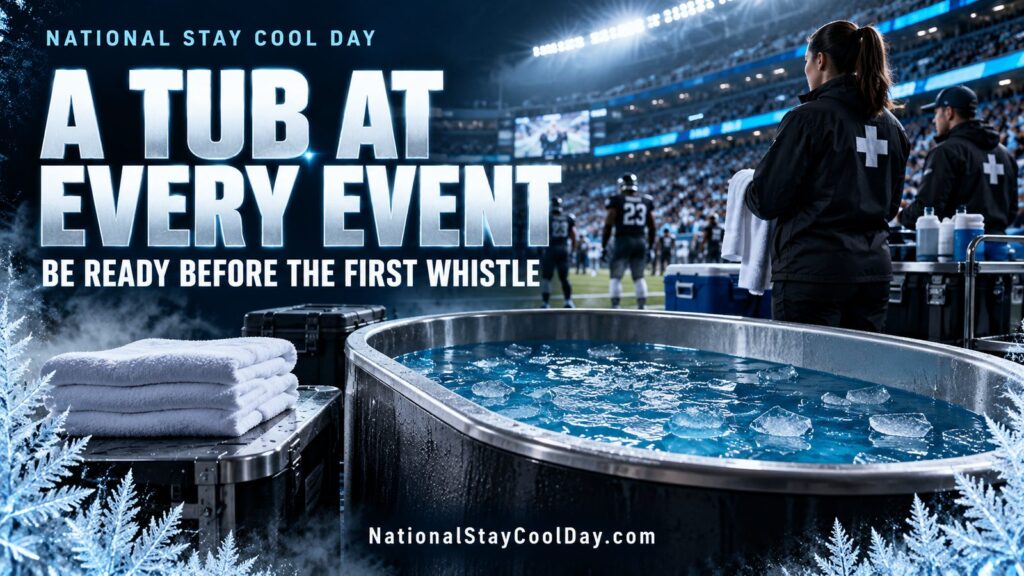
Every athletic event plans for the emergency it hopes never happens. Fields have an AED. Staff know where the ambulance gate is. Exertional heat stroke belongs on that same list, and the equipment that treats it is a tub, water and ice. It costs about as much as a team’s warm-up shirts and fits in the bed of a pickup truck.
This article explains why a cold-water immersion tub belongs at every practice, game and tournament played in warm weather, what the national standards say, what to buy, and how to set it up so it is ready in seconds.
Heat Stroke Does Not Check an Athlete’s History
Exertional heat stroke happens when the body makes heat faster than it can get rid of it. Core temperature climbs until the brain and organs start to fail. The signs are changes in how the athlete acts: confusion, stumbling, irritability, collapse, or loss of consciousness during or after activity.
It strikes healthy, fit athletes who have never had a heat problem before. The National Athletic Trainers’ Association (NATA) position statement on exertional heat illnesses states that heat illness occurs in conditions that look normal, especially during the first week of practice, and that all appropriate precautions belong in place regardless. The same statement names heat stress from the previous day as one of the best predictors of heat illness. A tournament weekend stacks those risks: several games in one day, little recovery between them, and athletes who traveled from cooler climates. The American Academy of Pediatrics lists “closely scheduled same-day training sessions or rounds of sports competition” among the main heat-illness risk factors for young athletes.
No one can predict which athlete, which day or which game. That is exactly why the treatment has to be on site before the first whistle.
The Clock Is 30 Minutes
Exertional heat stroke is one of the most survivable emergencies in sports when cooling starts right away. The standard is clear:
- Start cooling within 10 minutes of collapse.
- Cool to about 102°F within 30 minutes, then transport.
NATA sets the goal of lowering core temperature below 102°F within 30 minutes of collapse. The 2018 consensus statement on prehospital care of exertional heat stroke, written for EMS systems, explains why: when cooling is delayed, organ damage, illness and death rise significantly after 30 minutes, and that window is shorter than the average EMS transport and emergency department evaluation. The American College of Sports Medicine’s 2023 expert consensus statement puts it in three words: time is tissue. It calls stopping activity and providing rapid total body cooling essential for survival.
Why the Ambulance Ride Comes Second
An ambulance is the right call, and someone dials 911 the moment heat stroke is suspected. But an ambulance cannot give full-body immersion on the way to the hospital. Every minute spent loading, driving and waiting in an emergency department is a minute without the fastest cooling there is.
That is why the rule is cool first, transport second. NATA states that when medical staff are on site, every athlete with exertional heat stroke is cooled first and transported second. The prehospital consensus statement calls neck-down cold-water immersion the current best practice and says that when athletic trainers or physicians are on site, cooling is finished on site before transfer.
Only Immersion Reliably Beats the Clock
Cold-water immersion is the gold standard because water pulls heat out of the body far faster than air, towels or ice packs.
- NATA puts the cooling rate of cold-water immersion at about 0.2°C (0.37°F) per minute across the full immersion period.
- A study of 274 exertional heat stroke cases treated with on-site immersion over 18 years at a large road race found an average cooling rate of 0.22°C (about 0.4°F) per minute.
- The Society of Critical Care Medicine’s 2025 heat stroke guideline found that cold-water or ice-water immersion produces the fastest drop in temperature and the shortest time to target, and tells clinicians to prioritize it.
- A systematic review of whole-body cooling methods in the Journal of Athletic Training concluded that ice-water and cold-water immersion are the methods proven to have the fastest cooling rates.
Cold towels, fans, ice packs and dousing all cool more slowly. They are a bridge while the tub is filled, not the treatment. Our companion article on why cold towels and ice water fall short covers the numbers.
What the National Standards Say
NATA has said for years that the tub belongs on site. Its 2015 position statement on exertional heat illnesses says emergency supplies and equipment, including “tubs for cold-water immersion” and a rectal thermometer, “should be onsite, easily accessible, and in good working order to allow for immediate intervention and treatment if needed.”
NATA’s 2024 position statement on emergency action plans goes further. It says emergency equipment, naming an AED or a whole-body cold-water immersion vessel, “should be available, readily accessible, and clearly identifiable with proper signage at all athletic events.” It also says emergency action plans belong in “all organized sports at every level,” including youth play.
Rules and laws are catching up at different speeds. Florida and Maryland require schools to be ready to cool with cold-water immersion. Those laws cover schools. Most youth tournaments’ published rules do not yet require a tub, and state laws generally do not reach private events. That leaves the decision with each event, league and venue, and the guidance points one way.
“We Haven’t Had One Yet”
It is a reasonable thing to hear from an organizer with years of safe events, and it deserves a straight answer.
- Past events do not predict the next one. Heat stroke is rare at any single event and has no warning pattern. A clean record means the plan has not been tested, not that it is not needed.
- The same logic already applies to the AED. Most events never use their defibrillator, and no one leaves it home. NATA’s 2024 statement lists the AED and the immersion vessel side by side.
- The cost of being ready is small. A basic tub, ice and a few minutes of setup. The cost of not being ready is measured in minutes an athlete does not have.
- Families notice. A visible, signed cooling station tells parents and coaches that the event takes their athletes’ safety seriously.
What to Buy
A basic 100-gallon stock tank costs about $150 at farm and restaurant-supply retailers (October 2026 prices). The rest of the list is cheap or already in your equipment shed.
| Item | What to look for | Approximate cost |
|---|---|---|
| Stock tank or large tub | About 100 gallons or larger, deep enough to cover the torso. Poly tanks weigh about 30 pounds empty. | About $150 for 100 gallons; larger tanks cost more |
| Ice | Bagged ice in coolers next to the tub. NATA’s setup calls for 3 to 4 coolers of ice beside a half-filled tub. | About $3 to $7 per 20-pound bag |
| Water source | Hose, spigot or large water containers within reach of the tub | Usually on site |
| Paddle or long-handled scoop | For ice agitation: keeping the water moving the whole time | Low cost |
| Towels and a sheet | A sheet or towel wrapped across the chest and under the arms lets a helper keep the head above water | Already on hand |
| Rectal thermometer | The only accurate way to measure core temperature after hard exercise. Your medical team picks the device and trains the staff who use it. | Extra; varies by device |
| Tarp | Backup cooling if the tub is ever unavailable | Low cost |
| Sign | “Cold-Water Immersion” so anyone can find it fast, as NATA’s 2024 statement calls for | Low cost |
Purpose-built portable cooling systems and commercial cold tanks exist and cost more. A stock tank does the job the standards describe.
How to Stage It
- Put it close. Set the tub on the field or right next to it, in shade if you can, with a clear path for the ambulance. NATA’s setup places it on the playing field or in close proximity.
- Fill it before play. Half-fill the tub with water before the first game and keep 3 to 4 coolers of ice beside it. That way the tub does not have to stay iced all day, and ice goes in the moment it is needed. When the tub is in use, ice covers the surface of the water.
- Mark it. Post a sign and put the location on your emergency action plan and your field map.
- Assign roles. Name who calls 911, who brings the athlete to the tub, who supports the head, who handles ice agitation, who meets the ambulance and who measures temperature. Write the names down for every field and every shift.
- Talk to EMS before the event. Tell the local ambulance service you cool on site to about 102°F before transport, and share your plan.
- Rehearse. Walk the staff through a full run before the season or event starts. A plan nobody has practiced is slow when it counts.
When an Athlete Goes Down
- Stop activity and call 911. Start cooling at the same time. Do not wait for the ambulance.
- Put the athlete in the tub, covering as much of the body as possible, with the head and airway supported above the water.
- Remove anything you can quickly but don’t delay cooling because of gear removal.
- Keep up ice agitation the whole time and keep adding ice.
- Trained staff check core temperature with a rectal thermometer. Never delay cooling to take a temperature.
- Cool to about 102°F, then transport. Tell EMS what was done and when.
Our full guide to cold water immersion for heat stroke in schools covers setup, role assignments and what to do if something is missing.
Put the Tub in Your Plan
The free Emergency Action Plan Builder walks you through your venue’s plan, including where the cold-water immersion tub sits and who runs it. The free Heat Rules Card puts the tub location, the 911 address and the ambulance gate on one laminated page at the field. Both are on our free heat safety tools page, and nothing you type is sent anywhere.
Frequently Asked Questions
We have an ambulance on standby. Do we still need a tub?
Yes. An ambulance does not carry a full-body immersion tub. With a tub on site, the crew and your staff cool the athlete to about 102°F first and then transport, which is the standard of care.
Is a kiddie pool good enough?
Most kiddie pools are too shallow to cover the torso. A 100-gallon stock tank is deep enough, portable and inexpensive.
Does a tub need an athletic trainer to run it?
An athletic trainer or other trained medical professional is the best person to lead the response and measure core temperature. Coaches and staff trained on the plan can start cooling right away. Everyone on the emergency plan trains on it before the season.
Is a tub required at youth tournaments?
Most youth tournaments’ published rules do not require one, and state laws that require cold-water immersion cover schools. NATA’s 2024 statement says a whole-body cold-water immersion vessel should be at all athletic events, at every level.
How much ice do we need?
NATA’s setup keeps 3 to 4 coolers of ice next to a half-filled tub. Bring more on hot days and for long tournament days, and keep a plan to restock.
What about indoor events?
Heat stroke happens indoors too, in gyms without air conditioning and during hard conditioning. NATA’s 2024 statement applies to all athletic events. Our article on heat stroke in indoor sports covers the details.
What if the tub is in use or not ready?
Start cooling with whatever you have, such as ice towels rotated over the whole body or cold water poured over the athlete, while the tub is prepared. These cool more slowly than immersion, so get the athlete into the tub as soon as it is ready.
Be Ready by April 8, 2027
National Stay Cool Day is April 8, 2027. Before spring seasons and tournament schedules fill up, put a tub on your equipment list and your emergency plan. Then sign your school or program up to take part. It is free.
References
- National Athletic Trainers’ Association. Position Statement: Exertional Heat Illnesses. Journal of Athletic Training. 2015;50(9):986-1000. pmc.ncbi.nlm.nih.gov/articles/PMC4639891
- National Athletic Trainers’ Association. Position Statement: Emergency Action Plan Development and Implementation in Sport. Journal of Athletic Training. 2024. pmc.ncbi.nlm.nih.gov/articles/PMC11220767
- Consensus Statement: Prehospital Care of Exertional Heat Stroke. Prehospital Emergency Care. 2018;22(3):392-397. doi.org/10.1080/10903127.2017.1392666
- American College of Sports Medicine. Expert Consensus Statement on Exertional Heat Illness: Recognition, Management, and Return to Activity. Current Sports Medicine Reports. 2023;22(4):134-149. journals.lww.com/acsm-csmr
- Society of Critical Care Medicine. Guideline for the Treatment of Heat Stroke. 2025. sccm.org
- Effectiveness of cold water immersion in the treatment of exertional heat stroke at the Falmouth Road Race. Medicine & Science in Sports & Exercise. 2015;47(2):240-245. pubmed.ncbi.nlm.nih.gov/24983342
- Acute whole-body cooling for exercise-induced hyperthermia: a systematic review. Journal of Athletic Training. 2009;44(1):84-93. pmc.ncbi.nlm.nih.gov/articles/PMC2629045
- American Academy of Pediatrics. Climatic Heat Stress and Exercising Children and Adolescents. Pediatrics. 2011;128(3):e741-e747. pubmed.ncbi.nlm.nih.gov/21824876
- Florida Statutes § 1006.165. flsenate.gov/Laws/Statutes/2026/1006.165
- Maryland Chapter 163 (2024), HB 1219. mgaleg.maryland.gov
This article is for education and planning. It does not replace medical advice. Review all medical steps with your team physician or medical director. In an emergency, call 911.