October 24, 2026
Heat Doesn’t End in August: Heat Stroke in Indoor Sports
Most heat safety talk happens in August, when football and band camp start in the sun. Then the season turns, practices move inside, and the tub goes back in storage. But exertional heat stroke is not only a summer problem. It comes from the heat a hard-working body makes, and that heat does not care what month it is.
Winter sports are starting now. In its October 21, 2026 release, NFHS noted that late October is when preparations begin for basketball, wrestling, ice hockey and other winter sports. Wrestling alone had 300,214 boys and 74,064 girls taking part in 2024-25, according to NFHS. This post covers heat stroke in indoor sports: what changes indoors, what wrestling learned the hard way, and what every gym, mat room and weight room can put in place this week.
The short version: heat stroke can happen indoors and in winter. Measure the heat inside the room, keep water close, ban sauna suits and rubber suits, watch for rapid weight loss, and keep a cooling tub plan for indoor events too.
Why heat stroke can happen indoors and in winter
Your body makes heat when it works hard. Sweating is one of the main ways it sheds that heat, and the sweat has to evaporate to cool you. Anything that piles on heat or blocks that cooling raises the risk: hard effort, a warm room with still air, layers of clothing, and not drinking enough.
The National Athletic Trainers’ Association’s position statement on exertional heat illnesses says heat stroke is most likely in hot, humid weather, but “it can manifest with intense physical activity in the absence of extreme environmental conditions.” Its list of risk factors includes high-intensity exercise, dehydration, and gear or uniforms that hold heat in.
Indoor heat is also easy to miss. OSHA’s heat hazard guidance puts it plainly: “A weather report cannot gauge conditions inside a building.” It can be cold outside while a packed gym, a closed-up mat room, or a weight room with no air moving is warm inside. The only way to know is to measure inside the room where athletes are working.
What wrestling learned in 1997
Between November 7 and December 9, 1997, three previously healthy college wrestlers in North Carolina, Wisconsin and Michigan died while trying to lose weight fast before weigh-ins. The CDC’s report in the Morbidity and Mortality Weekly Report (February 20, 1998) describes the same pattern in all three: they restricted food and fluids, wore vapor-impermeable suits under cotton warm-ups, and exercised hard in hot environments. The report found clear signs of dehydration in all three and said hyperthermia may have contributed.
The CDC called these the first identified deaths in collegiate wrestling, and the first deaths linked to intentional rapid weight loss in high school or college wrestling since national record keeping began in 1982. All three happened in November and December.
After the deaths, the NCAA rewrote its weight-loss and weigh-in rules and added penalties, the CDC report notes. The NCAA’s Weight Management Program, with goals set in 1998, still shapes college wrestling today. Its stated goals include setting a healthy weight class early in the season and eliminating “the tools used to accomplish rapid dehydration.”
The rules today, in high school and college
Both levels now test hydration before setting a wrestler’s lowest weight, and both limit how fast a wrestler can drop weight. Here is what the current rule books say.
| High school (NFHS) | College (NCAA men’s wrestling) | |
|---|---|---|
| Who runs it | Each state association must run a weight-control program (NFHS Rule 1-5) | NCAA Weight Management Program, Rules 8 and 9 |
| Hydration test before body fat is measured | Hydration test with specific gravity no greater than 1.025 | Witnessed urine sample, specific gravity 1.020 or lower |
| Lowest body fat used to set minimum weight | 7% for boys; 19% for girls starting in 2026-27 (raised from 12%). Below that requires a medical release. | 5% (most common preseason calculation) |
| How fast weight can come off | A monitored descent plan. State programs such as Texas’s cap it at 1.5% of body weight per week. | No more than 1.5% of body weight per week, never adjusted |
| Sauna, sweat suits, hot rooms | A 2022 NFHS article by three physicians says these should be prohibited | Banned: saunas during the season, vapor-impermeable suits, hot rooms, hot boxes and steam rooms |
NCAA rules also require the wrestling room to start practice at no more than 80 degrees Fahrenheit, with “every effort” made to hold that temperature through practice (NCAA Rule 9). If your state association does not set a room temperature, ask your athletic trainer what target makes sense for your room.
NFHS has been direct about why this matters. A 2022 NFHS article on weight cutting, written by three physicians, says intentional dehydration “is dangerous, can lead to significant medical problems, including death,” and that it impairs the body’s ability to control its temperature, raising the risk of heat illness and heat stroke. The NATA statement adds that “rubber or plastic suits used for weight loss” keep sweat from evaporating, which blocks the body’s ability to cool off.
It is not only wrestling
Any indoor activity with hard effort, warm air and not enough water carries the same basic risk. That includes:
- Basketball and volleyball, especially preseason conditioning and long tournament days
- Indoor track, with repeated hard efforts in a closed building
- Cheer and dance, where practices run long and athletes may skip water
- Band and color guard practicing inside in full or heavy uniforms
- Weight rooms and conditioning sessions with little airflow
- Any gym that gets hot when it is full of people
None of this means indoor sports are unsafe. It means the same habits that protect athletes in August are worth keeping in January.
A checklist for gyms, mat rooms and weight rooms
- Measure inside. Check the temperature and humidity in the room where athletes are working, not just the weather outside. Use the heat chart your state association and medical team have set.
- Move the air. Use ventilation, fans and air conditioning where you have them. Keep doors open when it is safe to do so.
- Keep water close. Water within reach at every break, and any time an athlete asks.
- No sauna suits, rubber suits or plastic layers. No saunas, hot rooms or steam rooms for making weight.
- Watch for rapid weight loss. Weigh athletes before and after practice. NCAA guidance says a wrestler who loses 1 to 2 percent of body weight in a day, or on back-to-back days, should get back to normal hydration before practicing again.
- Know the warning signs. Collapse, confusion, irritability, aggressiveness, seizures, or not acting like themselves during or after hard exercise. When in doubt, treat it as heat stroke.
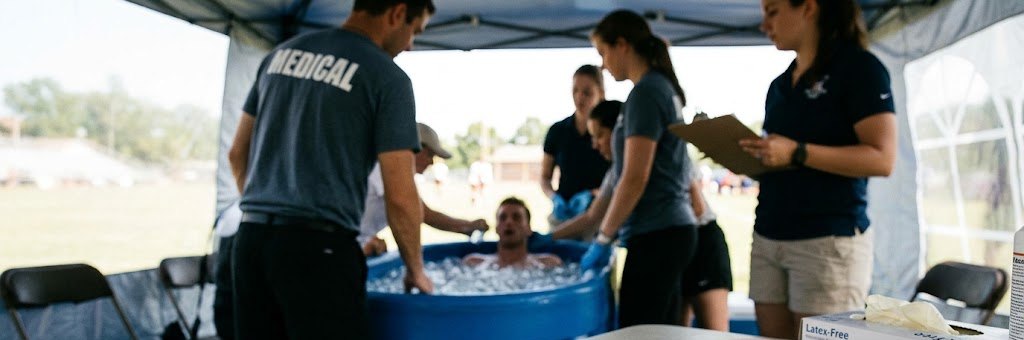
- Have a cooling tub plan indoors too. Decide where the tub goes for each indoor venue, where the ice comes from, who fills it, and who starts cooling. Medical staff should have a rectal thermometer ready.
- Hold a medical timeout before each contest. NFHS recommends a short medical timeout before each contest to review defibrillator locations and make sure everyone knows their job. Add the cooling tub to that list.
- Plan for more than one athlete. Weigh-in days and tournaments put many athletes through the same stress at the same time. Know where a second tub or a tarp is.
If heat stroke is suspected: Cool first, transport second
- Call 911 and start cooling on site. Both happen at the same time.
- Fully submerge the athlete to the neck in cold water, with the head and airway supported. Stir the water.
- Start cooling within 10 minutes, reach 102°F within 30 minutes.
- Medical staff stop cooling at about 101–102°F rectal, under medical direction. Then transport.
This follows the NATA position statement, which calls cold-water immersion up to the neck “the most effective cooling modality” for exertional heat stroke, sets the goal of lowering core temperature below 102°F (38.9°C) within 30 minutes of collapse, and says that when medical staff are on site, athletes with heat stroke “should be cooled first and transported second.”
Build your indoor plan
Our free Emergency Action Plan Builder lets you list every venue, including gyms and mat rooms, with its own tub location, defibrillator location and ambulance gate. It also includes a one-page medical timeout card you can bring to the pre-contest huddle.
Sources
- NFHS, Emergency Action Plans, AEDs Essential for Upcoming Events in High School Sports, Performing Arts (October 21, 2026)
- NFHS, Adjustment in Minimum Body Fat Percentage for Females Highlights High School Wrestling Rules Changes (April 16, 2026) and 2026-27 wrestling rules changes
- NFHS, Rules in Place to Guard Against Weight Cutting in Wrestling (October 5, 2022)
- University Interscholastic League (Texas), Wrestling Minimum Weight Certification Program Information
- NCAA, 2025-26 and 2026-27 Men’s Wrestling Rules, Rules 8 and 9
- NCAA, 2026-27 Men’s Wrestling Weight Management Packet
- CDC, Hyperthermia and Dehydration-Related Deaths Associated with Intentional Rapid Weight Loss in Three Collegiate Wrestlers, MMWR 1998;47(6):105-108
- National Athletic Trainers’ Association, Position Statement: Exertional Heat Illnesses, Journal of Athletic Training, 2015
- OSHA, Heat Hazard Recognition
This article is for planning and education. It does not replace medical advice. Work with your athletic trainer, team physician and local emergency medical services on your plan.