October 17, 2026
Tournament Heat Safety: Keeping Athletes Safe on Multi-Game Days
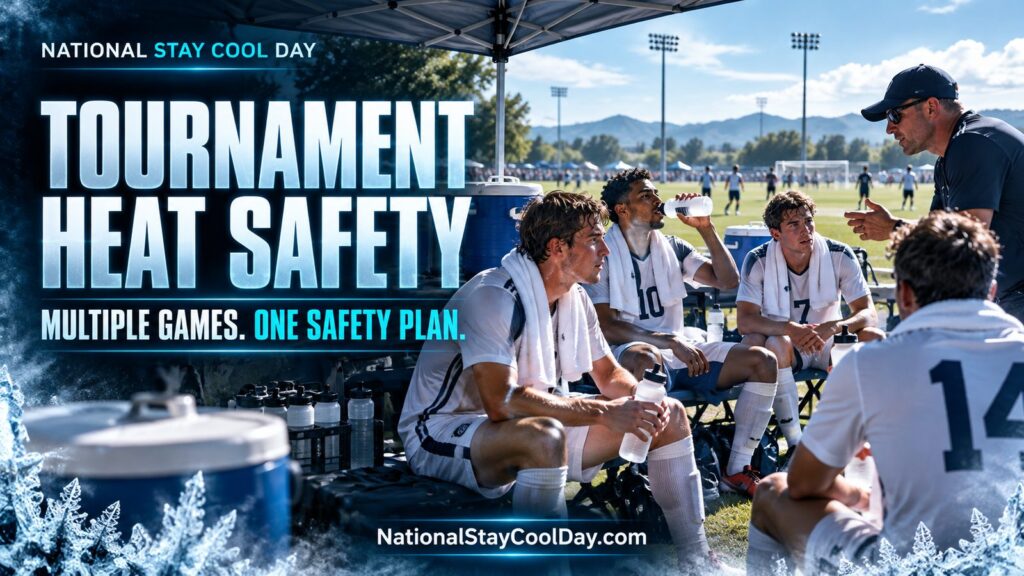
A tournament weekend asks more of an athlete’s body than almost anything else in youth sports. Two, three or four games in a day, short gaps between them, a hotel bed the night before and often a different climate from home. Every one of those adds heat stress, and it builds from one game to the next.
This guide covers why multi-game days raise heat risk, and what organizers, coaches and parents can do about it, using the National Athletic Trainers’ Association (NATA) position statement on exertional heat illnesses and other published guidance.
Why Tournament Days Raise Heat Risk
- Back-to-back games. The American Academy of Pediatrics lists “insufficient recovery between repeated exercise bouts or closely scheduled same-day training sessions or rounds of sports competition” among the key heat-illness risk factors for young athletes.
- Dehydration that adds up. NATA notes that cumulative dehydration builds over several days and shows up in tournament competition. During intense exercise in the heat, sweat rates reach 2 liters an hour. Fluid not replaced by the next game raises the risk of heat illness.
- Yesterday’s heat. NATA identifies heat stress on the previous day as one of the best predictors of heat illness. Saturday’s games carry into Sunday.
- Short nights. NATA encourages at least 7 hours of sleep in a cool environment because heat effects are cumulative. Late games, early start times and shared hotel rooms cut into that.
- Travel. Teams from cooler regions have not adapted to the heat at the host site. Research on high school football in Georgia found higher heat illness rates among athletes from the cooler northern part of the state at similar heat readings, a gap the authors tied to acclimatization.
A Tournament Day, Hour by Hour
| When | What to do |
|---|---|
| Night before | At least 7 hours of sleep in a cool room. Eat a full dinner and drink fluids. |
| Morning | Eat breakfast and drink before arriving. Check urine color: light means hydrated. Weigh in if your athletic trainer tracks it. |
| Warm-up | Keep it short on hot days. Use shade. |
| During games | Drink at every break and whenever thirsty. Use every timeout and substitution to cool down. Remove helmets and extra gear on the bench. |
| Between games | Get out of the sun and into air conditioning or deep shade. Eat, drink fluids with sodium and rest. Stay off your feet. |
| After the last game | Replace fluids and food, cool down indoors, and sleep well before day two. |
For Organizers
- Put a cold-water immersion tub at every field complex. NATA’s 2024 position statement on emergency action plans says a whole-body cold-water immersion vessel should be available, readily accessible and clearly marked with signage at all athletic events, and that its recommendations apply at every level, including youth. A basic 100-gallon stock tank costs about $150. Read why every practice and event needs a cold-water immersion tub on site.
- Staff medical coverage. NATA identifies athletic trainers and other health care providers as the primary providers of care for heat illness, with the authority to pull an athlete from play. Place them where they can reach every field quickly.
- Measure WBGT on each surface. A 2017 study in the Journal of Athletic Training found wet bulb globe temperature varied widely between athletic surfaces and that weather-service estimates put teams in the wrong activity category 45% of the time. Turf, track and clay complexes need readings on site.
- Write a heat policy with clear triggers. Decide in advance what happens at each heat level: extra breaks, shorter games, equipment limits, longer gaps between games, and when play stops. NATA calls for event guidelines based on the type of activity and WBGT.
- Schedule around the heat. Schedule as many games as you can early and late in the day. The CDC advises scheduling activity earlier or later in the day when it is cooler.
- Give teams enough time between games. NATA advises rest periods that include meals and allow 2 to 3 hours for food, fluids and electrolytes to be digested and absorbed before the next session. Build the bracket with that in mind.
- Provide shade and water. Shade structures and water refill stations at every field cluster. NATA calls for free access to fluids at all times.
- Brief EMS and share the plan. Tell the local ambulance service that heat stroke is cooled on site before transport. Give every team a map with the tub, the medical tent and the ambulance entrance.
For Coaches
- Rotate players. Use depth to limit minutes for athletes who played heavy minutes earlier in the day.
- Track hydration. NATA’s goals are to keep body mass loss under 2% from before to after activity and to keep morning urine light in color. A bathroom scale and a quick check before and after games help.
- Use the time between games. Get the team into air conditioning or deep shade. Feed them. Keep them off hot pavement and out of the sun.
- Sit out sick athletes. NATA says athletes with a fever or a viral illness should not play until it resolves.
- Follow the same-day rule. NATA states that after heat exhaustion, same-day return to activity is not recommended. That means no more games that day, even in a playoff.
- Find the medical tent and the tub before the first game. Know who to call and where to go.
For Parents
- Pack a large refillable water bottle, sports drinks, salty snacks, real meals, sunscreen, a shade tent or umbrella and a cooler of ice.
- Protect sleep at the hotel. A cool room and a reasonable bedtime matter.
- Spend the time between games somewhere cool, not in the sun.
- Ask where the athletic trainer and cooling tub are. See our questions every parent should ask about heat safety.
- Tell the coach if your athlete has been sick, has had a past heat illness or feels “off.”
When an Athlete Goes Down
Confusion, stumbling, odd behavior or collapse in the heat is heat stroke until proven otherwise, even if the athlete is still sweating.
- Call 911 and start cooling at the same time. Do not wait for the ambulance.
- Put the athlete in a tub of ice water, covering as much of the body as possible, with the head supported above the water.
- Remove anything you can quickly but don’t delay cooling because of gear removal.
- Keep up ice agitation the whole time.
- Start cooling within 10 minutes and cool to about 102°F within 30 minutes, then transport.
Cold towels and ice packs are a bridge while the tub is filled, not the treatment. Read why cold towels, ice packs and fans don’t treat heat stroke.
Frequently Asked Questions
How much rest do athletes need between games in the heat?
NATA advises rest periods that include meals and allow 2 to 3 hours for food and fluids to be absorbed before the next session. Spend that time somewhere cool.
Can an athlete play the next game after heat exhaustion?
No. NATA states that same-day return to activity after heat exhaustion is not recommended. The athlete is done for the day.
Are tournaments required to have a cooling tub?
Most youth tournaments’ published rules do not yet require one, and state laws that require cold-water immersion cover schools. NATA’s 2024 statement says a whole-body cold-water immersion vessel should be available at all athletic events.
Is a heat index forecast enough to run the day?
Use forecasts to plan the schedule and on-site WBGT readings to make calls. Weather-service estimates misclassified the heat category 45% of the time in a 2017 study comparing them with on-site readings.
What should a team bring if the host site has no tub?
A stock tank, coolers of ice and access to water fit in a pickup truck. Confirm with the organizer ahead of time where it can be set up.
Plan Your Season
Build your event or team plan with the free Emergency Action Plan Builder and post your heat levels on a Heat Rules Card. National Stay Cool Day is April 8, 2027. Sign your program up.
References
- National Athletic Trainers’ Association. Position Statement: Exertional Heat Illnesses. Journal of Athletic Training. 2015;50(9):986-1000. pmc.ncbi.nlm.nih.gov/articles/PMC4639891
- National Athletic Trainers’ Association. Position Statement: Emergency Action Plan Development and Implementation in Sport. Journal of Athletic Training. 2024. pmc.ncbi.nlm.nih.gov/articles/PMC11220767
- American Academy of Pediatrics. Climatic Heat Stress and Exercising Children and Adolescents. Pediatrics. 2011;128(3):e741-e747. pubmed.ncbi.nlm.nih.gov/21824876
- Regional differences in exertional heat illness rates among Georgia USA high school football players. International Journal of Biometeorology. 2020;64(4):643-650. doi.org/10.1007/s00484-019-01853-4
- The heat strain of various athletic surfaces: a comparison between observed and modeled wet-bulb globe temperatures. Journal of Athletic Training. 2017;52(11):1056-1064. pmc.ncbi.nlm.nih.gov/articles/PMC5737042
- Centers for Disease Control and Prevention. Heat and Athletes. cdc.gov/heat-health/risk-factors/heat-and-athletes.html
This article is for education and planning. It does not replace medical advice. Review all medical steps with your team physician or medical director. In an emergency, call 911.