October 28, 2026
Why Cold Towels, Ice Packs and Fans Don’t Treat Heat Stroke
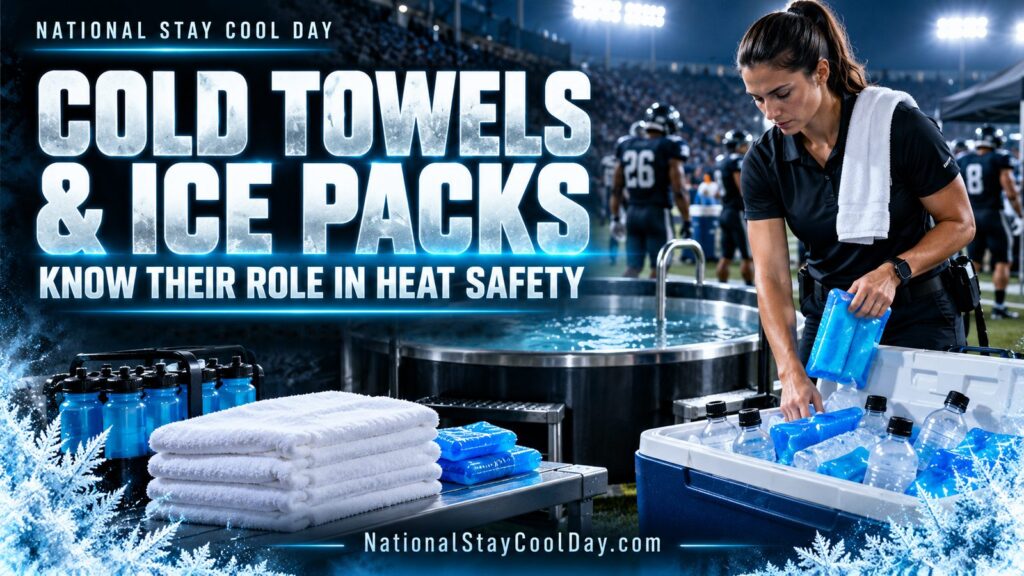
When an athlete collapses in the heat, people grab what is close: cold towels, ice packs, a fan, a spray bottle, a cup of ice water, a spot in the shade. Every one of those helps a little. None of them is fast enough to treat exertional heat stroke. The treatment that works is full-body cold-water immersion with ice agitation, and the reason comes down to how heat leaves the body.
This article explains why the common fixes fall short, what the published cooling rates show, and what to do in the rare case you truly have no tub.
The Goal Sets the Standard
Exertional heat stroke is a medical emergency defined by brain changes (confusion, stumbling, collapse, unresponsiveness) and a dangerously high core temperature. The goal is fixed:
- Start cooling within 10 minutes of collapse.
- Cool to about 102°F within 30 minutes, then transport.
The National Athletic Trainers’ Association (NATA) sets the 30-minute target, and the 2018 consensus statement on prehospital care of exertional heat stroke says organ damage, illness and death rise significantly when cooling is delayed past 30 minutes. A cooling method is only as good as its ability to hit that target. That is the test every option below has to pass.
Why Water Wins
The body sheds heat four ways: radiation, conduction (direct contact, such as an ice pack), convection (moving air or water across the skin) and evaporation of sweat. NATA’s position statement describes each one.
Water moving across the whole body combines conduction and convection over nearly all of the skin at once. That is why immersion, with someone stirring the water and adding ice, cools so much faster than anything else. Ice agitation matters: NATA calls for the water to be stirred continuously, because still water next to hot skin warms up and slows cooling.
Every alternative loses on one of two counts. It covers too little skin, or it relies on air instead of water.
The Common Fixes, One by One
Cold towels
A few towels on the forehead and neck cover a small fraction of the body, and they warm quickly against hot skin. Towels help only when they are soaked in ice water, cover the whole body and are swapped out constantly. Even then, NATA lists ice towels as an option when immersion is not available and states they are not as effective as cold-water immersion.
Ice packs on the neck, armpits and groin
Ice packs at those spots are a common first-aid tip, and they cool by conduction through a few small patches of skin. That is far too little surface area to pull heat out of a body in heat stroke at the rate the 30-minute goal demands. The Society of Critical Care Medicine’s 2025 guideline tells clinicians to prioritize the methods that cool fastest, and it names cold-water or ice-water immersion as the method with the fastest cooling rate and the shortest time to target temperature.
Fans and misting
Fans and misters depend on evaporation. Air carries heat away much more slowly than water. On a humid day, evaporation slows even further, which is the same reason the athlete overheated in the first place. Fans help with heat exhaustion. They do not treat heat stroke.
Shade and air conditioning
Moving out of the sun stops the athlete from gaining more heat from the sun. It does almost nothing to remove the heat already built up inside the body. Shade is the right place to set up the tub, not a substitute for it.
Drinking ice water
Fluids prevent dehydration and help an athlete with heat cramps or heat exhaustion who is alert and able to drink. They are not a cooling treatment for heat stroke. No major guideline lists drinking as a way to treat exertional heat stroke; NATA, the American College of Sports Medicine and the Society of Critical Care Medicine all point to immersion. An athlete who is confused or drifting in and out of consciousness also cannot drink safely.
What the Cooling Rates Show
Researchers measure cooling in degrees per minute of core temperature. The table below lists rates from published studies. The cold-water immersion rates come from real heat stroke patients and NATA’s summary of the research. The other rates come from controlled studies of volunteers who were heated through exercise and then cooled.
| Method | Cooling rate | Source |
|---|---|---|
| Cold-water immersion (274 heat stroke patients treated on site at a road race) | 0.22°C (about 0.40°F) per minute | Medicine & Science in Sports & Exercise, 2015 |
| Cold-water immersion (NATA summary of the research) | About 0.2°C (0.37°F) per minute | NATA position statement, 2015 |
| Tarp-assisted cooling with oscillation (athlete wrapped in a tarp filled with water, rocked back and forth) | 0.116°C (about 0.21°F) per minute | Applied Ergonomics, 2022 |
| Dousing with water, then lying in a light breeze | 0.088°C (about 0.16°F) per minute | Wilderness & Environmental Medicine, 2023 |
| Water poured over the torso on a tarp, without rocking | 0.076°C (about 0.14°F) per minute | Wilderness & Environmental Medicine, 2023 |
| Fan plus a wet T-shirt | 0.074°C (about 0.13°F) per minute | Applied Ergonomics, 2022 |
| Fan only | 0.065°C (about 0.12°F) per minute | Applied Ergonomics, 2022 |
The pattern is plain. Immersion cools roughly twice as fast as the best alternative in the table and about three times as fast as a fan. A 2025 review of prehospital cooling in the European Journal of Medical Research states that rapid cooling faster than 0.15°C per minute is crucial for survival and names water immersion the gold standard. Only immersion clears that bar. A 2009 systematic review in the Journal of Athletic Training reached the same conclusion: ice-water and cold-water immersion are the methods proven to cool fastest.
If You Truly Have No Tub
The answer to “we have no tub” is to get one. A basic 100-gallon stock tank costs about $150 (October 2026 prices). Here is why every practice and event needs a cold-water immersion tub on site. Until then, or if the tub is in use, never wait. Call 911 and start cooling with what you have. Treat these as a bridge to immersion, not an equal.
- Tarp-assisted cooling. Lay the athlete on a tarp, have helpers lift the edges to form a trough around the body, pour in water and ice, and rock the tarp to keep the water moving. In the 2022 military study, this was the fastest of the alternatives tested, but it still cooled at roughly half the rate of immersion.
- Rotating ice towels over the whole body. Soak towels in ice water, cover as much of the body as possible, and swap them for fresh, cold towels constantly. NATA lists this as an alternative that is not as effective as immersion.
- Continuous cold-water dousing with fanning. Pour cold water over the athlete nonstop while someone fans. The 2009 systematic review named this the alternative to use until a better method is available.
Whatever you use, keep going until EMS takes over, and tell the crew exactly what cooling was done and when. Then make sure the next practice has a tub.
What to Do Instead: The Immersion Steps
- Call 911 and start cooling at the same time. Do not wait for the ambulance.
- Put the athlete in a tub of ice water, covering as much of the body as possible, with the head and airway supported above the water.
- Remove anything you can quickly but don’t delay cooling because of gear removal.
- Keep up ice agitation the whole time and keep adding ice.
- Trained staff check core temperature with a rectal thermometer. Never delay cooling to take a temperature.
- Cool to about 102°F, then transport.
For the full setup, roles and equipment list, read Cold Water Immersion for Heat Stroke in Schools. To spot heat stroke early, see Exertional Heat Stroke Symptoms Every Coach and Parent Should Know, and for why only a rectal reading counts, see Why Rectal Temperature Is the Only Reliable Way to Diagnose Heat Stroke.
Frequently Asked Questions
Do ice packs on the neck, armpits and groin treat heat stroke?
No. They cool a few small patches of skin. Heat stroke needs whole-body cooling, and cold-water immersion is the fastest method there is.
Are cold towels better than nothing?
Yes, as a bridge while the tub is being filled or the ambulance is on the way. Use ice-soaked towels over the whole body and swap them constantly. They do not replace immersion.
Should we give an athlete with heat stroke ice water to drink?
No. Drinking does not cool the body fast enough to treat heat stroke, and an athlete who is confused or losing consciousness cannot drink safely. Put the athlete in the tub.
Is a cold shower good enough?
A shower wets the skin but does not surround the body with cold, moving water. Use a tub. If an athlete collapses right next to the athletic training room, NATA notes a whirlpool tub or cold shower is an option there, and full immersion is still the goal.
What is tarp-assisted cooling?
The athlete lies on a tarp while helpers lift the edges to hold water and ice around the body, then rock it to keep the water moving. It is the best backup when no tub is available, and it is still slower than immersion.
Doesn’t the ambulance cool the athlete?
An ambulance cannot provide full-body immersion on the road. That is why the rule is cool first, transport second.
Get Your Tub and Your Plan Ready
Build your venue’s plan with the free Emergency Action Plan Builder, and post the tub location on your free Heat Rules Card. National Stay Cool Day is April 8, 2027. Sign your school or program up and make immersion part of every season.
References
- National Athletic Trainers’ Association. Position Statement: Exertional Heat Illnesses. Journal of Athletic Training. 2015;50(9):986-1000. pmc.ncbi.nlm.nih.gov/articles/PMC4639891
- Consensus Statement: Prehospital Care of Exertional Heat Stroke. Prehospital Emergency Care. 2018;22(3):392-397. doi.org/10.1080/10903127.2017.1392666
- American College of Sports Medicine. Expert Consensus Statement on Exertional Heat Illness: Recognition, Management, and Return to Activity. Current Sports Medicine Reports. 2023;22(4):134-149. journals.lww.com/acsm-csmr
- Society of Critical Care Medicine. Guideline for the Treatment of Heat Stroke. 2025. sccm.org
- Acute whole-body cooling for exercise-induced hyperthermia: a systematic review. Journal of Athletic Training. 2009;44(1):84-93. pmc.ncbi.nlm.nih.gov/articles/PMC2629045
- Effectiveness of cold water immersion in the treatment of exertional heat stroke at the Falmouth Road Race. Medicine & Science in Sports & Exercise. 2015;47(2):240-245. pubmed.ncbi.nlm.nih.gov/24983342
- Efficiency of three cooling methods for hyperthermic military personnel linked to water availability. Applied Ergonomics. 2022;102:103700. pubmed.ncbi.nlm.nih.gov/35231652
- Tarp-assisted cooling for exertional heat stroke treatment in wildland firefighting. Wilderness & Environmental Medicine. 2023;34(4):490-497. pubmed.ncbi.nlm.nih.gov/37748988
- Pre-hospital cooling in community-acquired heat stroke: evidence, challenges, and strategies. European Journal of Medical Research. 2025;30(1):472. pmc.ncbi.nlm.nih.gov/articles/PMC12153164
This article is for education and planning. It does not replace medical advice. Review all medical steps with your team physician or medical director. In an emergency, call 911.