
October 27, 2026
Cooling Station Checklist: What Every Practice Field Needs Before Kickoff
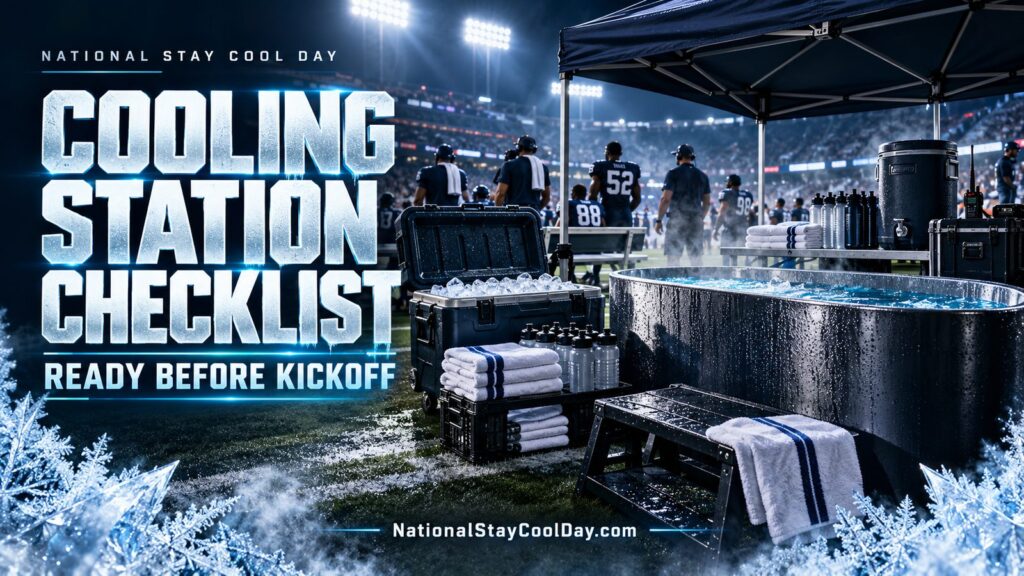
Every practice field needs a cooling station that is set up, stocked and staffed before the first whistle. Exertional heat stroke is treated where the athlete falls, not at the hospital. When an athlete collapses, there is no time to find the key to the shed, run for ice or figure out who calls 911. The station is either ready or it is not.
This checklist covers what belongs at a field-side cooling station, how to check it before kickoff and how to reset it afterward. Print it, assign each line to a person and walk it before every hot practice and game.
Why the Station Has to Be Ready Before Play
The National Athletic Trainers’ Association (NATA) states that emergency supplies and equipment, including tubs for cold-water immersion and a rectal thermometer, should be on site, easily accessible and in good working order so care can start immediately. NATA also calls for onsite facilities for immediate whole-body cooling, because cooling is what treats heat stroke.
The standard of care is clear: start cooling within 10 minutes and cool to about 102°F within 30 minutes, then transport. A station that takes 20 minutes to assemble already misses that window. Set it up first, then start practice.
Cooling tubs are not required by most youth tournaments’ published rules or by state law outside schools. Florida and Maryland require them for schools. NATA recommends a tub on site, and a basic stock tank costs about $150. Every program can do this.
The Cooling Station Checklist
1. Immersion
- Stock tank or large tub big enough to cover the torso, on the field or right next to it. For sizing and buying details, read why every practice and event needs a cold-water immersion tub on site.
- Water in the tub before play. NATA’s setup half-fills the tub with water before the event and keeps coolers of ice right beside it, so ice goes in the moment it is needed.
- Ice on hand. NATA’s setup calls for 3 to 4 coolers of ice next to a half-filled tub. Know where more ice comes from if the day runs long.
- Water source within reach: a hose, spigot or large water containers.
- Paddle or scoop so a helper keeps up ice agitation the whole time an athlete is in the tub.
- Towels and a sheet. A sheet or towel wrapped across the chest and under the arms lets a helper keep the head above water. Extra towels soaked in ice water go over the head and neck during cooling.
- A clear path into and out of the tub, with enough room for several people to lift an athlete in and out.
2. Temperature and Records
- Rectal thermometer access according to your school’s or program’s medical policy. Rectal temperature is the only accurate way to measure core temperature after hard exercise. Your medical team chooses the device and trains the staff who use it. Read why rectal temperature is the only reliable way to diagnose heat stroke.
- Gloves and supplies that go with the thermometer, stored with it.
- A watch or phone clock and a log sheet to record when the athlete went down, when cooling started, each temperature reading and when the ambulance left.
3. Shade, Water and Rest
- Shade from a canopy, tent or building. NATA calls for rest breaks in the shade or in a predetermined cooling zone, not in direct sunlight.
- Unlimited water and sports drinks with enough bottles or cups for every athlete to drink at every break.
- Room to take gear off. NATA calls for athletes to be allowed to remove equipment such as helmets during rest breaks.
- Ice towels in a cooler for comfort during breaks. They are for rest and recovery. They do not treat heat stroke. Read why cold towels, ice packs and fans don’t treat heat stroke.
4. Communication
- A charged phone or radio with the person in charge of the station, plus a backup.
- The field address and entrance written down at the station so whoever calls 911 reads it off instead of guessing.
- The posted Heat Rules Card showing your heat levels, break rules and emergency steps.
- Today’s heat reading, taken on site, with the activity level it sets for the day. Read WBGT for schools for how to take a reading that counts.
5. EMS Access
- Gates unlocked or a named person holding the key during practice.
- A clear route from the street to the station, with no parked cars or equipment blocking it.
- A person assigned to meet the ambulance and walk the crew to the station.
- Your local EMS service briefed before the season that your staff cool on site to about 102°F and then transport.
6. People
- Named roles for every practice: who calls 911, who brings the athlete to the tub, who supports the head, who handles ice agitation, who takes temperature and who meets the ambulance.
- A backup for each role in case someone is off the field or with another team.
- Every coach trained to recognize heat stroke and start cooling. NATA calls for coaches, administrators, security staff and EMS to be educated on recognizing heat illness and for every site to practice its emergency action plan.
Write all of it into a site-specific plan with the free Emergency Action Plan Builder. Printable sideline cards, including a heat-ready sideline checklist, are on the School Heat Resources page.
The Pre-Kickoff Walk-Through
Before every hot practice or game, one person walks the station and checks each line out loud:
- Tub in place, water in, ice beside it.
- Paddle, sheet and towels at the tub.
- Thermometer and supplies where the plan says, with a trained person on site.
- Shade up and water stocked.
- Phone or radio charged and in hand.
- Address and entrance posted at the station.
- Gate open and EMS route clear.
- Heat reading taken and the activity level for the day set.
- Every role named, with a backup.
- Everyone on staff knows where the tub is.
If any line fails, fix it before athletes start. A missing tub is a reason to delay practice, not a reason to hope nothing happens.
When an Athlete Goes Down
Confusion, stumbling, odd behavior or collapse during or after activity in the heat is heat stroke until proven otherwise, even if the athlete is still sweating.
- Call 911 and start cooling at the same time.
- Put the athlete in the tub, covering as much of the body as possible, with the head supported above the water.
- Remove anything you can quickly but don’t delay cooling because of gear removal.
- Keep up ice agitation the whole time.
- Start cooling within 10 minutes and cool to about 102°F within 30 minutes, then transport.
After Practice: Reset the Station
- Drain and rinse the tub, and store it where tomorrow’s setup crew can reach it.
- Restock ice, towels, drinks, gloves and log sheets.
- Clean and store the thermometer according to your medical team’s instructions.
- Charge phones and radios.
- Note anything that slowed the walk-through and fix it before the next session.
Frequently Asked Questions
Does every practice field need its own cooling station?
Every field where athletes work hard in the heat needs immediate access to cold-water immersion. If two fields are side by side, one station between them works when it is close enough to start cooling right away. Fields across campus each need their own.
Who should run the station?
An athletic trainer leads it when one is on site. Coaches are trained on the same steps, because heat stroke does not wait for the athletic trainer to arrive.
Are cold towels and a fan enough for a cooling station?
No. Towels, fans and shade help athletes recover during breaks. Heat stroke needs cold-water immersion with ice agitation.
What if the field has no water hookup?
Bring water in large containers and fill the tub before practice. Plan the water the same way you plan the ice.
Does National Stay Cool Day provide equipment?
National Stay Cool Day does not provide or offer equipment. The free planning tools and printable cards on this site help schools and programs set up their own stations.
National Stay Cool Day Is April 8, 2027
National Stay Cool Day is a free national day for schools and programs to put heat plans in place before the season. Sign your school or program up.
References
- National Athletic Trainers’ Association. Position Statement: Exertional Heat Illnesses. Journal of Athletic Training. 2015;50(9):986-1000. See recommendations 5, 6, 7, 11 and 12, Table 4 and the Appendix. pmc.ncbi.nlm.nih.gov/articles/PMC4639891
This article is for education and planning. It does not replace medical advice. Review all medical steps with your team physician or medical director. In an emergency, call 911.