
November 10, 2026
Tennis Heat Safety: Hot Courts, Long Matches and Players on Their Own
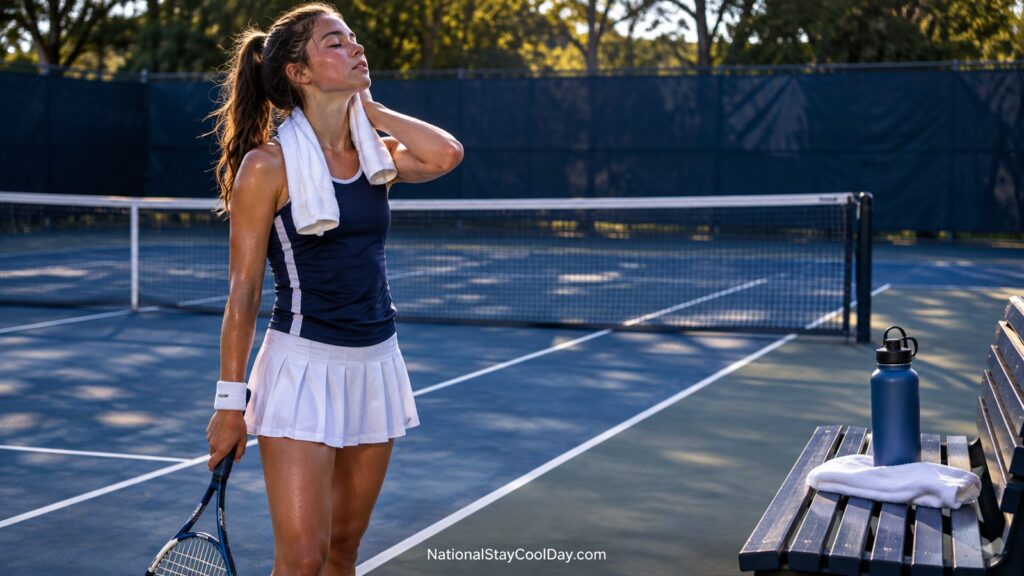
Tennis doesn’t look like a dangerous sport in the heat. There’s no contact, no pads, and players get a break every couple of games. But a hard court in the afternoon sun holds heat like a parking lot, matches can run for hours, and a player in trouble is often alone on a court far from the bench. That combination is why tennis deserves its own heat plan.
Exertional heat stroke is 100% survivable when the player is cooled fast, on site. Everything below is about making that possible at a tennis complex.
Why Tennis Is Different
- The court itself is hot. Hard courts soak up sun and give it back. It can feel much hotter on the court than in the parking lot or the shade by the fence.
- Matches don’t have a set length. A close match can go far longer than anyone planned, and the hottest stretch of the day often lands in the middle of it.
- Players are spread out. A team match might use six or more courts at once. A coach can’t watch every player, and some courts sit at the far end of the complex.
- Players are often on their own. In many matches, a player decides when to drink, when to sit and whether to keep going. Competitive players are the least likely to stop.
- Tournament days stack up. Singles in the morning, doubles after lunch and a backdraw match late in the day can add up to a long day in the sun. Our guide to multi-game tournament days covers the recovery side.
Before the Season
- Write a plan for each site you play at, including away courts and public parks. Our free emergency action plan builder gives you a finished plan in your school’s name, with a section for more than one athlete going down.
- Know the address and gate for every court complex. Many public courts have one entrance, and an ambulance needs to know which one.
- Ease players into the heat over the first two weeks. See heat acclimatization for athletes.
- Learn how to read heat conditions on the court, not just the forecast. Our WBGT guide for schools explains how.
On Match Day
- Set up a cooling station where it can reach every court, not just the one closest to the bench. Use our cooling station checklist. A cold-water immersion tub belongs at every event, including tennis.
- Put an adult in sight of every court. If one coach can’t see them all, assign a parent volunteer or assistant to the far courts, and tell them what to watch for.
- Get water and shade to the court. Players should not have to walk to the clubhouse to drink. Make sure every bench has water and some shade if the site allows it.
- Check in between matches. Before a player goes back out, look at them and talk to them. A player who seems off should not start another match.
- Tell players it is OK to stop. Say it out loud before the match: if you feel confused, dizzy or wrong, stop and get help. No match is worth it.
MISSING: state association, league and tournament rules on heat breaks, extreme-heat delays and medical timeouts in tennis were not verified here. Check the rules for your state association or tournament before match day.
Know the Signs
Heat stroke in tennis can look like a bad day on the court. Watch for a player who is confused, gives strange answers, misses easy balls, loses track of the score, stumbles, or seems “out of it.” A player may still be sweating. Collapse or a seizure is an emergency. When in doubt, treat it as heat stroke. Read exertional heat stroke symptoms every coach and parent should know.
Teammates on the next court often notice first. Share our guide on looking out for teammates with your players.
When a Player Goes Down
- Stop play and get to the player. Don’t wait for the point or the game to finish.
- Call 911 and start cooling at the same time. One person calls and gives the court address and gate. Another starts cooling.
- Cool first, transport second. Get the player into the cold-water immersion tub. Remove anything you can quickly but don’t delay cooling because of gear removal.
- Use ice agitation. Keep the ice and water moving around the player.
- Send someone to the gate to meet the ambulance and walk them to the right court.
Cooling should start within 10 minutes. The goal is to bring body temperature down to about 102°F within 30 minutes, because at 104°F the body loses its ability to regulate its own temperature. Cold towels and ice packs are not enough. Read cool first, transport second and why cold towels don’t treat heat stroke.
Before the season starts, walk through these steps with your staff at the courts you use most. Our guide to running a heat stroke drill shows how.
Bring Your Team Into National Stay Cool Day
National Stay Cool Day is April 8, 2027, during the spring season for many school tennis teams. Schools, coaches and youth programs can take part. Here’s how schools and programs can sign up.