
November 16, 2026
Ice Bath Safety for Athletes: Using Cold-Water Immersion for Exertional Heat Stroke
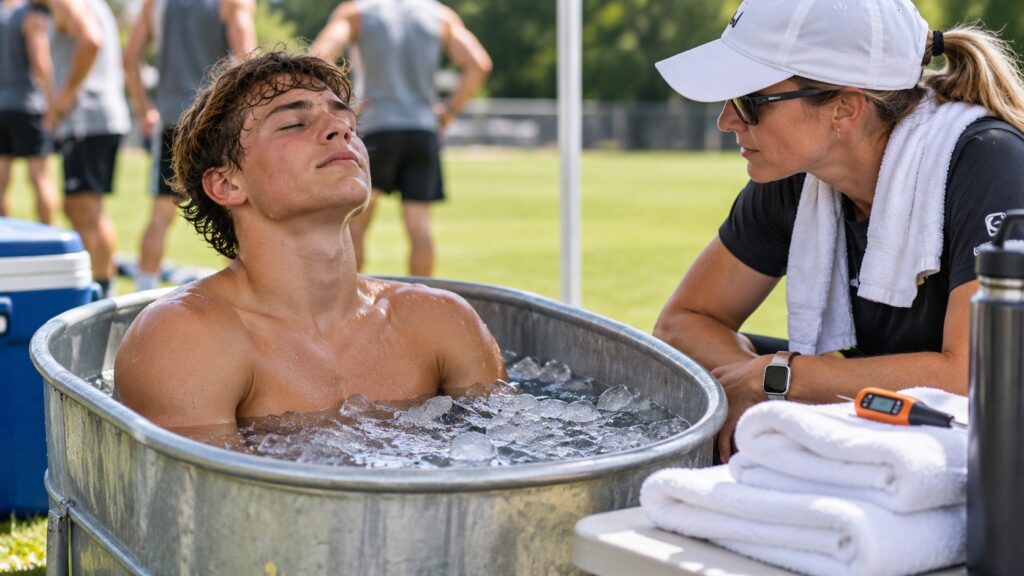
An ice bath on the sideline is cold-water immersion for suspected exertional heat stroke. Call 911 right away, while cooling starts. Immerse the body, keep the head and airway above the water, and stir ice water about 35–59°F. Start cooling within 10 minutes. Reach 102°F within 30. Then transport. This page is about emergency treatment, not a wellness plunge.
Do this now.
- Call 911 right away, while cooling starts.
- Get the athlete into the ice bath, with the head and airway supported above the water.
- Use ice water about 35–59°F and keep stirring.
- Start cooling within 10 minutes. Reach 102°F within 30.
- Then transport. Cool First, Transport Second.
This page is for education and planning. It does not replace an athletic trainer, team physician or EMS. For the full school protocol, including setup, roles and field steps, use cold-water immersion for heat stroke in schools.
An ice bath for heat stroke is not a wellness cold plunge
In sports medicine, an ice bath is a cold-water immersion tub used on site to treat suspected exertional heat stroke. The athlete is immersed in ice water so the body can be cooled fast, with the head and airway kept above the water.
A recreational cold plunge, or a wellness soak after a workout, is a different activity. It is not the subject of this page, and the steps below are not a recovery routine.
When an ice bath is the right tool
Use the ice bath when you suspect exertional heat stroke: an athlete who is confused, stumbling, collapsing or otherwise “out of it” during or after hard work in the heat. An athlete with heat stroke may still be sweating. Do not wait for a temperature reading to start cooling. Never delay cooling to take a temperature. For the signs, read exertional heat stroke symptoms every coach and parent should know.
Used the right way, cold-water immersion is the first-line cooling method in guidance from the National Athletic Trainers’ Association (NATA) and in National Federation of State High School Associations (NFHS) heat-illness guidance, which prefers ice-water baths when they are available. The case for that method is in cold-water immersion as first-line treatment.
Exertional heat stroke is 100% survivable when the athlete is cooled fast, on site. That is a statement about heat stroke, not a claim that immersion itself is 100% safe. At least 175 documented exertional heat stroke deaths have been recorded. Fast, on-site cooling is how you give the athlete a chance.
How to use a sideline ice bath safely
Keep this checklist short and follow it in order. The school protocol page has the full field steps, equipment list and staff roles.
- Call 911 right away, while cooling starts.
- Move the athlete to the tub, or the tub to the athlete.
- Remove anything you can take off quickly, but do not delay cooling because of gear removal.
- Immerse the body in ice water about 35–59°F. Keep the head and airway supported above the water.
- Keep stirring the ice and water around the athlete, and add ice so the surface stays covered.
- If trained staff can measure rectal temperature, stop cooling at about 102°F. If you cannot take a temperature, keep cooling and follow the no-thermometer rule written in your emergency action plan. Never delay cooling to take a temperature.
- Then transport. Cool First, Transport Second.
Start cooling within 10 minutes. Reach 102°F within 30. Cold towels, ice packs and fans can help as a bridge. They are not the treatment. Read why cold towels don’t treat heat stroke and the cooling station checklist. For why rectal temperature is the reliable reading when it is measured, see why rectal temperature is the only reliable way to diagnose heat stroke.
Call 911 right away, while cooling starts
Call 911 right away, while cooling starts. One person calls and gives the exact address and the gate or road the ambulance should use. Another person starts cooling. Do not hold the ice bath until the ambulance arrives. An ambulance cannot give full-body immersion on the way to the hospital.
Tell the dispatcher that you are cooling the athlete on site and will follow Cool First, Transport Second. Share that plan with your local EMS agency before the season, so the handoff is not a surprise. The rule itself is explained at Cool First, Transport Second.
What to do if there is no tub
Start cooling with what you have while someone gets a tub ready or EMS takes over. Existing school guidance uses a tarp with ice and water, or rotating ice-water towels, as a bridge. Get the athlete into a tub as soon as one is ready. Heat stroke also happens indoors, in hot gyms and field houses. See indoor gym heat safety and why every event needs a tub.
When something else comes first (no pulse, no breathing, or an unsafe airway)
A few situations change the order of care. None of them mean skipping cooling once it can be done safely.
- No pulse or not breathing. Start CPR and use an AED first. Resume cooling as soon as the medical lead says it is safe.
- An unsafe airway or an active seizure. Protect the airway and keep the athlete from injury. Begin cooling as soon as it can be done safely.
If there is no athletic trainer or nurse on site, call 911 and start cooling with what is available. Do not wait for medical staff to arrive.
Put the ice bath in the written plan
Safe use depends on a written, venue-specific emergency action plan that names who calls 911, who starts cooling, where the tub and ice are, and how the ambulance gets in. Write the plan, post it at the venue, share it with EMS and rehearse it. Our free EAP Builder produces a finished plan in the school’s name. Our guide to running a heat stroke drill shows how to practice the steps. More school tools are on School Heat Resources and free heat safety tools for schools.
National Stay Cool Day is Thursday, April 8, 2027. Getting the ice bath into the plan, and rehearsing it, is a concrete way to be ready. Schools and programs can take part at no cost. Here’s how to join.
FAQ
Is an ice bath safe for treating exertional heat stroke?
Used the right way, an ice bath is the first-line cooling method for suspected exertional heat stroke in NATA position statements and in NFHS heat-illness guidance, which prefers ice-water baths when they are available. Call 911 right away, while cooling starts. Keep the head and airway above the water. Stir ice water about 35–59°F. Start cooling within 10 minutes. Reach 102°F within 30. Then transport. This is emergency treatment, not a wellness plunge.
What water temperature should an ice bath be for heat stroke?
Use ice water about 35–59°F and keep stirring, with ice covering the surface. That range is the cooling method already used in National Stay Cool Day’s approved school guidance. Follow any tighter instruction from your team physician or medical director.
How long should an athlete stay in the ice bath?
Start cooling within 10 minutes. Reach 102°F within 30. If trained staff can measure rectal temperature, stop cooling at about 102°F, then transport. If you cannot take a temperature, keep cooling and follow the no-thermometer rule in your emergency action plan. Do not end cooling early because the athlete looks better or because EMS has arrived, unless the medical lead or EMS directs a change.
Should the athlete’s head be under the water?
No. Immerse the body and keep the head and airway supported above the water the whole time.
Is a recreational cold plunge the same as a heat-stroke ice bath?
No. A wellness or recovery cold plunge is a different activity. This page is only about using a cold-water immersion tub to treat suspected exertional heat stroke on the sideline.
What if there is no tub on site?
Start cooling with a tarp and ice water, or with rotating ice-water towels, while someone prepares a tub or EMS takes over. These methods cool more slowly than immersion, so get the athlete into a tub as soon as one is ready.
When do you call 911?
Call 911 right away, while cooling starts, as soon as you suspect exertional heat stroke. Do not wait for a temperature reading, and do not wait for the ambulance to arrive before you start cooling.
Who should lead the ice-bath response?
An athletic trainer, when one is on site, should lead the response and measure core temperature if that is part of your protocol. If no athletic trainer is there, the person named in your emergency action plan starts cooling and stays with the athlete until EMS takes over. Name that person, and a backup, before the season.
Sources
- National Athletic Trainers’ Association. Position Statement: Exertional Heat Illnesses (2015). NATA PDF. Open full text: PMC4639891.
- National Athletic Trainers’ Association. Position Statement: Emergency Action Plan Development and Implementation in Sport (2024). PMC11220767. Lists a whole-body cold-water immersion vessel among emergency equipment that should be available at athletic events.
- National Federation of State High School Associations Sports Medicine Advisory Committee. Heat Acclimatization and Heat Illness Prevention Position Statement (April 2022). NFHS PDF. On-site rapid cooling should begin immediately; ice-water baths are the preferred method when available; “cool first, transport later.”
- NFHS. Heat illness prevention and management. nfhs.org.
- American College of Sports Medicine. Expert Consensus Statement on Exertional Heat Illness (2023). PubMed 37036463.
- DeMartini et al. Falmouth Road Race cold-water immersion outcomes (2015). PubMed 24983342. Field-outcome support already cited on National Stay Cool Day’s cold-water immersion pages.
- CDC. Heat and Athletes. cdc.gov.
- Heat.gov (National Integrated Heat Health Information System). heat.gov.
- National Weather Service. Heat safety. weather.gov/safety/heat.
This article is for education and planning. It does not replace an athletic trainer, team physician or EMS. Review medical steps with your team physician or medical director. In an emergency, call 911.