October 30, 2026
Cold Water Immersion Is the Only Defensible First-Line Treatment for Exertional Heat Stroke
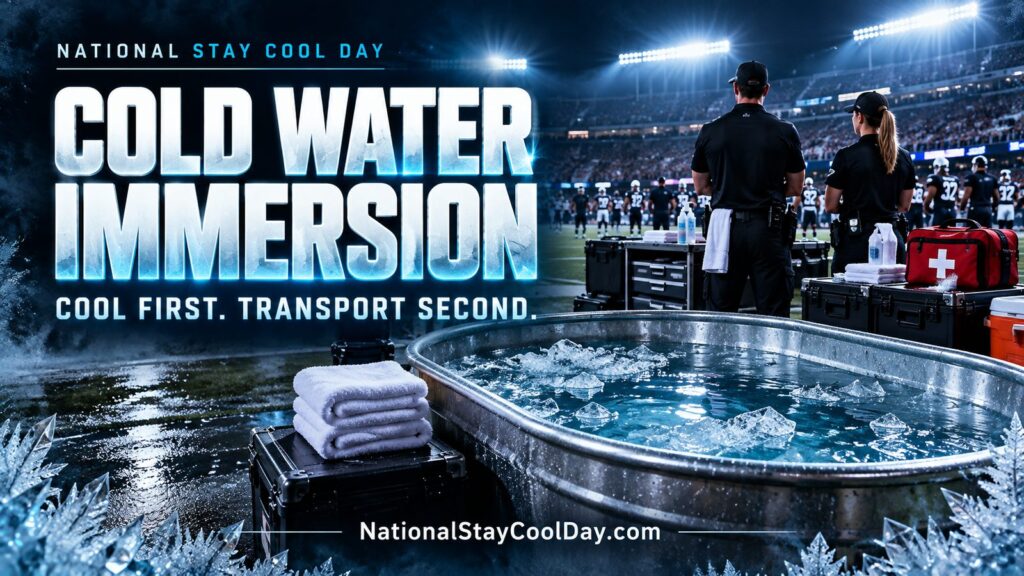
Every year, athletes die from exertional heat stroke (EHS) in circumstances that were entirely preventable. The treatment that would have saved them existed on the sideline. The knowledge of how to use it was available in the medical literature. What failed was not science. What failed was the decision made in the first minutes after collapse.
This article makes a single, direct argument: cold water immersion (CWI) is not merely a good option for treating exertional heat stroke. It is the only first-line treatment that the clinical evidence consistently supports, and choosing anything else in a setting where CWI is available is an indefensible departure from the standard of care.
The core fact: Start cooling within 10 minutes of collapse and reach about 102°F within 30 minutes, and you give the athlete the best chance there is. When cooling is delayed or replaced with slower methods, the risk of death and permanent organ damage rises sharply.
The sections below walk through the physiology, the cooling rate data, the field outcomes, the most common objections, and a practical checklist. If you are an athletic trainer, coach, or event safety officer, this is the case for why your emergency action plan must include CWI as the explicit, non-negotiable first response to suspected EHS.
What Exertional Heat Stroke Actually Does to the Body
Exertional heat stroke is defined by two simultaneous findings: a core body temperature above 104°F, measured rectally, and central nervous system (CNS) dysfunction, which shows up as confusion, combativeness, loss of coordination, or collapse. It is one of the leading causes of sudden death in athletes, and its lethality is directly tied to a single variable: how long the core temperature stays dangerously high.
That 104°F figure is the diagnostic threshold only. It is never a reason to wait. If heat stroke is suspected, call 911 and start cooling at the same time.
The Cooling Rate Data
Water pulls heat from the body far faster than air. The National Athletic Trainers’ Association (NATA) calls cold-water immersion up to the neck “the most effective cooling modality for patients with EHS” and puts its cooling rate at about 0.2°C per minute, roughly 1°F every 3 minutes. The Society of Critical Care Medicine’s 2025 guidelines tell clinicians to choose cooling methods that reach at least 0.155°C per minute. Immersion clears that bar. Fans, cold towels and ice packs do not. For the side-by-side numbers, read Why Cold Towels, Ice Packs and Fans Don’t Treat Heat Stroke.
The Field Outcomes
The case for immersion rests on real patients. At the Falmouth Road Race in Massachusetts, the finish-line medical tent treated 274 cases of exertional heat stroke over 18 years with cold-water immersion, at an average cooling rate of 0.22°C (about 0.40°F) per minute. The published study recommends immediate on-site immersion for every case.
The Most Common Objections
“The ambulance is on the way.” An ambulance cannot hold a full-body tub of ice water, and the 30-minute window is shorter than a typical transport and hospital evaluation. Call 911 and start cooling at the same time. Cool first, then transport. Share that plan with your local EMS agency before the season so everyone follows the same handoff at about 102°F. Read more in Cool First. Transport Second.
“We don’t have a tub.” A basic stock tank costs about $150. A tub is not required by most youth tournaments’ published rules or by state law outside schools. Florida and Maryland require tubs for schools, and NATA recommends tubs on site. See Why Every Practice and Event Needs a Cold-Water Immersion Tub On Site.
“The athlete is still in pads.” Remove anything you can quickly but don’t delay cooling because of gear removal.
A Practical Checklist
- Stage a tub, water and ice near the field before activity starts.
- Call 911 and start cooling at the same time.
- Put the athlete in the tub up to the neck, with the head and airway supported above the water.
- Keep up ice agitation the whole time and keep adding ice.
- Trained staff check core temperature with a rectal thermometer. Never delay cooling to take a temperature.
- Cool to about 102°F, then transport.
For setup, staff roles and the full equipment list, read Cold Water Immersion for Heat Stroke in Schools. Every item on this list is simple. The consequences of skipping it can last a lifetime.
For programs building a complete heat safety infrastructure, including acclimatization schedules, WBGT monitoring protocols, and emergency action plan templates, National Stay Cool Day’s free heat safety tools provide a starting point that requires no budget and no specialized equipment to access.
The Standard of Care Is Not Ambiguous
The NATA, the American College of Sports Medicine (ACSM), the ILCOR First Aid Task Force, and the 2025 European Resuscitation Council guidelines all point in the same direction: immediate whole-body cold water immersion is the first-line treatment for exertional heat stroke in settings where it can be performed safely.
This is not a contested area of sports medicine. The debate ended when the field outcome data accumulated to the point where the evidence was overwhelming. What remains is not the science. It is the implementation: whether programs have the equipment, the written protocols, and the institutional authority to act on what the evidence demands.
The 30-minute window closes whether or not you have a tub on the sideline. The biology does not wait. An athlete in EHS loses ground with every minute the core temperature stays dangerously high, and no amount of ice packs, wet towels, or fan cooling applied after the fact will undo damage that accumulated during a delayed response.
The question for every athletic trainer, coach, and event safety officer reading this is not whether CWI works. The evidence settled that. The question is whether your program will be ready the next time an athlete needs it.
For additional resources on building a complete heat safety program, including the Acclimatization Schedule, the Heat Rules Card, and the Emergency Action Plan Builder, visit Free Heat Safety Tools for Schools. The tools are free. The cost of not using them is not.
References
- National Athletic Trainers’ Association. Position Statement: Exertional Heat Illnesses. Journal of Athletic Training. 2015;50(9):986-1000. pmc.ncbi.nlm.nih.gov/articles/PMC4639891
- American College of Sports Medicine. Expert Consensus Statement on Exertional Heat Illness: Recognition, Management, and Return to Activity. Current Sports Medicine Reports. 2023;22(4):134-149. journals.lww.com/acsm-csmr
- International Liaison Committee on Resuscitation (ILCOR) First Aid Task Force. First Aid Cooling Techniques for Heat Stroke and Exertional Hyperthermia: Systematic Review. costr.ilcor.org
- European Resuscitation Council Guidelines 2025: First Aid. erc.edu
- Society of Critical Care Medicine. Guidelines for the Treatment of Heat Stroke. Critical Care Medicine. 2025;53(2):e490-e500. sccm.org
- Effectiveness of cold water immersion in the treatment of exertional heat stroke at the Falmouth Road Race. Medicine & Science in Sports & Exercise. 2015;47(2):240-245. pubmed.ncbi.nlm.nih.gov/24983342
- Consensus Statement: Prehospital Care of Exertional Heat Stroke. Prehospital Emergency Care. 2018;22(3):392-397. doi.org/10.1080/10903127.2017.1392666
This article is for education and planning. It does not replace medical advice. Review all medical steps with your team physician or medical director. In an emergency, call 911.
Athletic trainer quick checklist
What is the sideline cold-water immersion protocol for exertional heat stroke?
Recognize collapse in the heat, call 911, immerse in ice water about 35–59°F, stir the water, keep the head out, and stop cooling at 102°F rectal. Cool first, transport second.
When should cooling start?
Start cooling within 10 minutes. Reach 102°F within 30. Call 911 while cooling is underway.