October 19, 2026
Spring Sports Heat Safety: Why the First Warm Days Catch Teams Off Guard
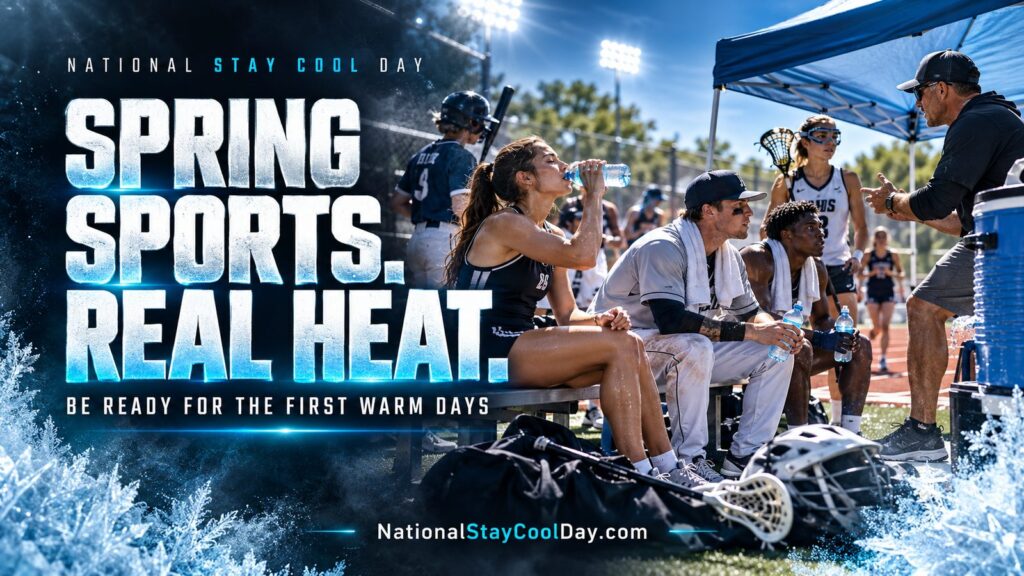
Spring seasons start in cold gyms, on frosty fields and under winter jackets. Then a warm spell arrives in March or April, practice heads outside at full speed, and athletes who have not felt real heat in months are suddenly working hard in it. That gap between the calendar and the body is what makes the first warm days of spring dangerous.
This guide explains why spring heat catches teams off guard, which spring sports carry extra risk, and a simple plan to get ready before the first hot practice.
Acclimatization Does Not Carry Over From Last Summer
The body adapts to heat with practice: sweating starts earlier, heart rate drops and core temperature stays lower. The National Athletic Trainers’ Association (NATA) says athletes should acclimatize to heat gradually over 7 to 14 days, and that the benefits fade within 3 weeks if they are not maintained. A winter indoors resets the clock. Every spring athlete starts the season unacclimatized.
NATA also identifies the first 2 to 3 weeks of a season as the period of greatest risk. In spring, that window often overlaps with the first warm spell of the year.
“Hot for Here” Matters More Than the Number
Heat illness tracks how hot a day is compared with what athletes are used to. A study of Georgia high school football players found that athletes in the cooler northern part of the state had higher heat illness rates than southern athletes at similar heat readings, a gap the authors linked to acclimatization. A review of marching band heat illness from 1990 to 2020 found that most events happened when the weather was unusually hot for the area.
That is why an 82-degree afternoon in early April deserves the same respect as a 95-degree day in August. NATA notes that heat illness occurs in conditions that look normal, especially early in a season, and that heat guidelines should be region specific.
Spring Sports With Extra Heat Risk
| Sport | Why it adds heat stress | What helps |
|---|---|---|
| Baseball and softball | Long innings in full sun, doubleheaders, catchers in full gear | Shade in dugouts, water every half inning, rotate catchers, gear off between innings |
| Track and field | All-day meets, distance events, hot synthetic tracks | Shade tents, cool-down area, cooling tub near the finish |
| Lacrosse | Helmets, pads and gloves, constant running | Phase in equipment, helmets off at breaks, more breaks as heat rises |
| Spring football | Full equipment returns after months off | Follow the equipment phase-in of an acclimatization schedule |
| Soccer and tennis | Continuous play, hot courts and turf | Scheduled water breaks, play early or late on hot days |
Surfaces matter. A 2017 study in the Journal of Athletic Training found that wet bulb globe temperature (WBGT) on black and red tracks and black tennis courts ran higher than National Weather Service estimates. NATA notes that protective equipment adds heat stress and should be phased in during acclimatization.
Your Spring Heat Plan
- Use an acclimatization schedule in spring too. Start with shorter outdoor sessions, limit equipment and build up over the first two weeks. The free Acclimatization Schedule builds one for you.
- Measure WBGT from the first outdoor practice. Do not wait for summer. Check on site, on the surface where athletes play, and follow your state association’s chart. Read WBGT for schools.
- Watch the 7-day forecast. The National Weather Service publishes WBGT forecasts up to a week ahead. When the first warm spell is coming, plan lighter practices and move them earlier or later in the day.
- Put the tub out early. Set up a cold-water immersion tub from the first warm practice, not the first summer practice. Read why every practice and event needs a tub on site.
- Update your emergency action plan. Spring sports use different fields, tracks and travel sites. Build a plan for each venue with the free Emergency Action Plan Builder.
- Make water and breaks routine. NATA calls for free access to fluids at all times and breaks in shade, with equipment off.
- Screen athletes. NATA recommends a preseason physical that asks about past heat illness. Athletes coming off a winter illness or a long break need extra attention.
- Post a Heat Rules Card at each spring venue so every coach knows the heat levels and the emergency details. Make one with the free Heat Rules Card.
Know the Signs and the Response
Confusion, stumbling, odd behavior or collapse during or after activity in the heat is heat stroke until proven otherwise, even if the athlete is still sweating.
- Call 911 and start cooling at the same time.
- Put the athlete in a tub of ice water, covering as much of the body as possible, with the head supported above the water.
- Remove anything you can quickly but don’t delay cooling because of gear removal.
- Keep up ice agitation the whole time.
- Start cooling within 10 minutes and cool to about 102°F within 30 minutes, then transport.
Cold towels and ice packs are not enough. Read why cold towels, ice packs and fans don’t treat heat stroke.
Frequently Asked Questions
Do spring athletes really need to acclimatize?
Yes. NATA says heat acclimatization fades within 3 weeks without heat exposure. After a winter indoors, every athlete starts over.
How hot is too hot in spring?
Use on-site WBGT and your state association’s chart. Remember that a day that is unusually warm for your area carries extra risk because athletes have not adapted.
Isn’t heat illness mostly an August problem?
Most reported high school heat illness happens in August preseason. A CDC analysis found 66.3% of time-loss heat illnesses occurred in August, the month most schools start preseason training. The same principle applies to spring: the start of a season, before athletes adapt, is when risk is highest.
When should the cooling tub come out?
From the first practice in warm weather. Heat stroke does not wait for summer.
Do indoor winter athletes switching to spring sports need a plan?
Yes. Indoor training builds fitness but not heat adaptation. Treat the first two weeks outdoors as acclimatization.
National Stay Cool Day Is April 8, 2027
National Stay Cool Day falls in April, right as spring seasons ramp up. It is the right moment to put your heat plan in place before the first hot practice. Sign your school or program up.
References
- National Athletic Trainers’ Association. Position Statement: Exertional Heat Illnesses. Journal of Athletic Training. 2015;50(9):986-1000. pmc.ncbi.nlm.nih.gov/articles/PMC4639891
- Regional differences in exertional heat illness rates among Georgia USA high school football players. International Journal of Biometeorology. 2020;64(4):643-650. doi.org/10.1007/s00484-019-01853-4
- Exertional heat illnesses in marching band artists: a case series. International Journal of Biometeorology. 2021;65(12):2181-2188. pubmed.ncbi.nlm.nih.gov/34424411
- The heat strain of various athletic surfaces: a comparison between observed and modeled wet-bulb globe temperatures. Journal of Athletic Training. 2017;52(11):1056-1064. pmc.ncbi.nlm.nih.gov/articles/PMC5737042
- Centers for Disease Control and Prevention. Heat Illness Among High School Athletes, United States, 2005-2009. MMWR. 2010;59(32):1009-1013. cdc.gov/mmwr/preview/mmwrhtml/mm5932a1.htm
- National Weather Service. Wet Bulb Globe Temperature: How and when to use it. weather.gov/news/211009-WBGT
This article is for education and planning. It does not replace medical advice. Review all medical steps with your team physician or medical director. In an emergency, call 911.