November 21, 2026
Tryouts Heat Safety: When Every Player Is Trying Not to Sit Out
Tryouts put a lot of heat risk into a few days. Players show up wanting to stand out, many of them are not used to hard work in the heat yet, and coaches are watching skills, not faces. Groups are bigger than a normal practice, and some of the kids are new to the coaches entirely.
Exertional heat stroke is 100% survivable when the athlete is cooled fast, on site. Tryouts deserve the same plan as a regular season practice, set up before the first player arrives.
Why Tryouts Carry Extra Risk
- Nobody wants to sit out. A player trying to make the team will hide how they feel. Asking for a break can feel like giving up a spot.
- Bodies are not ready yet. Tryouts often come early, before players have had time to adjust to the heat. Read why the first two weeks matter.
- Coaches are evaluating. Every adult is looking at footwork, speed and skill. Without a set job, no one is watching for heat illness.
- Strangers on the field. Coaches may not know a player’s normal behavior, so a change in how a kid acts is easier to miss.
- Big groups, hard drills. Conditioning tests and long stations with dozens of players make it easy for one player in trouble to blend in.
Before Tryouts Start
- Use your emergency action plan for the tryout field or gym. If you don’t have one, our free emergency action plan builder gives you a finished plan in your school’s name, including a section for more than one athlete going down. With a big tryout group, that section matters.
- Put names next to jobs: who calls 911, who starts cooling, who meets the ambulance.
- Give one adult the job of watching players, not evaluating them. That person does not hold a clipboard.
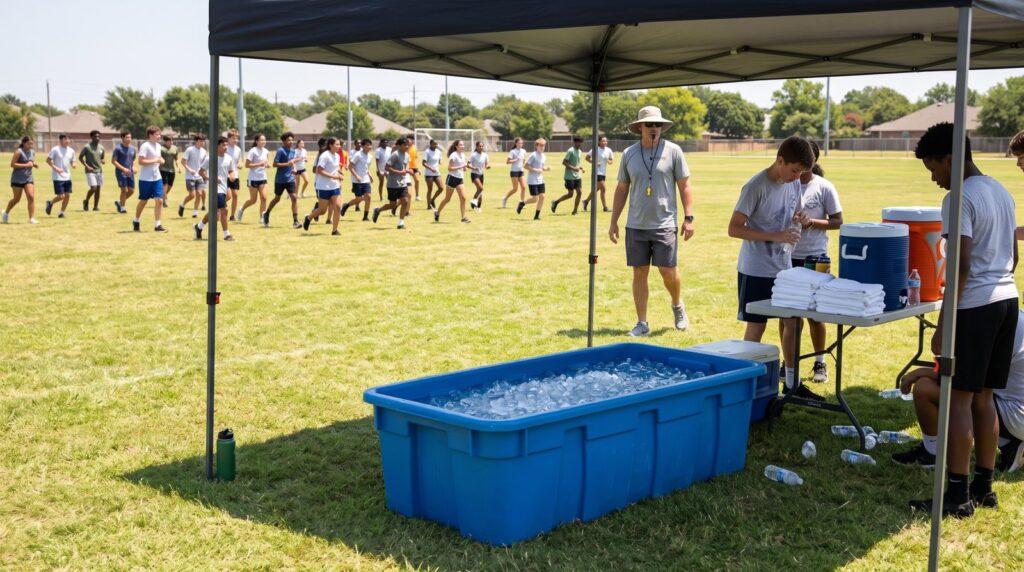
- Set up a cold-water immersion tub with ice before the first drill, close to where players work. Our cooling station checklist lists what to have ready.
- Collect emergency contacts and health forms before anyone steps on the field, including for players new to the program.
- Know the address and the gate an ambulance would use, and make sure it is unlocked.
- Check your state association or district rules for heat and for tryout schedules. MISSING: tryout heat rules and schedule limits vary by state and district and were not verified here; follow your state association or district.
Running a Safer Tryout
- Check heat and humidity right before tryouts start, not just that morning. Our WBGT guide explains how.
- Schedule water and shade breaks for everyone, and say out loud that taking them does not count against anyone.
- Put conditioning tests early in the session, or move them to a cooler time of day, instead of saving the hardest running for the end.
- Tell players at the start: if you feel wrong, tell an adult, and if a teammate looks off, tell an adult. Telling is the right call and will not hurt anyone’s chances. Our guide on looking out for teammates is written for athletes.
- Ask at check-in if anyone has been sick, skipped a meal or slept badly.
- Keep groups small enough that the watching adult can see every player.
Signs to Watch For
The most important sign is a change in how the brain is working. Act right away if a player:
- seems confused, gives strange answers or can’t follow simple directions
- stumbles, loses balance or suddenly falls behind in a drill
- acts out of character, seems “out of it” or stops responding normally
- collapses or has a seizure
They may still be sweating. Sweat does not rule out heat stroke. When in doubt, treat it as heat stroke. For the full list, read exertional heat stroke symptoms every coach and parent should know, and see heat cramps explained.
If a Player Goes Down
- Stop the drill and get to the player.
- Call 911 and start cooling at the same time. One person calls. Another starts cooling.
- Cool first, transport second. Cooling should start within 10 minutes. The goal is to bring body temperature down to about 102°F within 30 minutes.
- Use cold-water immersion with ice agitation. Get the player into the tub and keep the ice and water moving around them. See cold-water immersion for schools.
- Remove anything you can quickly but don’t delay cooling because of gear removal.
- Send someone to meet the ambulance at the gate and lead the crew straight to the player.
- Move the rest of the group to shade and water with another adult, and check them too.
- Call the family once cooling has started and 911 is on the way.
Why the rush: at 104°F, the body loses its ability to regulate its own temperature. Cold towels and ice packs are not enough. Read why cold towels don’t treat heat stroke and cool first, transport second.
After Tryouts
The first practices after the roster is set are still early in the heat season, so keep easing players in. A player who had heat stroke needs a doctor’s clearance and a slow return. Our guide to return to play after heat stroke covers what that looks like.
Parents can ask before tryouts where the cooling tub will be and who is watching players. Start with our list of heat safety questions parents should ask.
Bring Your Team Into National Stay Cool Day
National Stay Cool Day is April 8, 2027. Schools, coaches and youth programs can take part. Here’s how schools and programs can sign up.