
November 21, 2026
For School Nurses: Leading Heat Response When a Student Goes Down
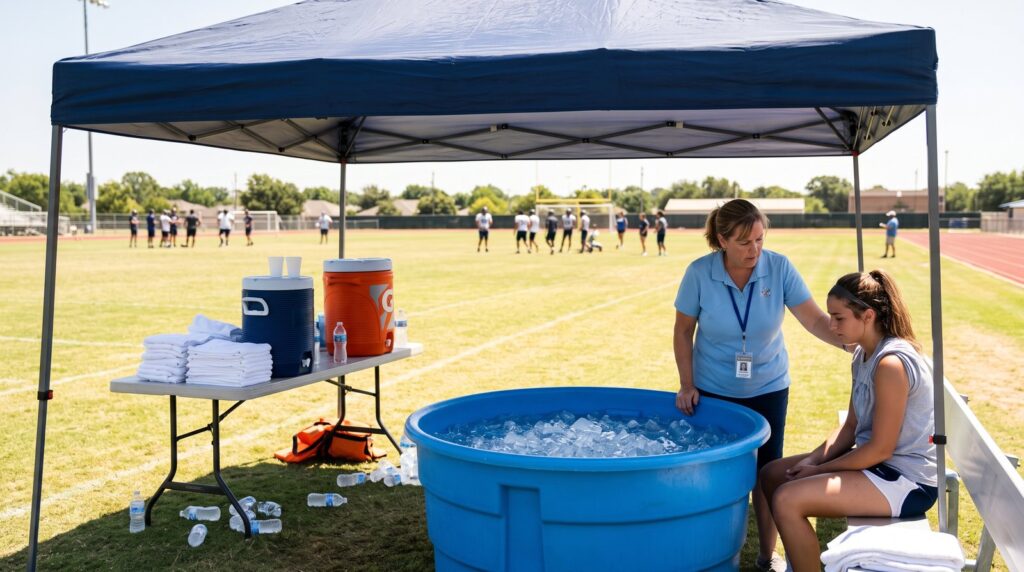
Most heat safety guides are written for coaches and athletic trainers. School nurses still get the call when a student goes down during PE, recess, band, practice or after school, and you may be the closest medical adult on campus.
An athletic trainer is not always on site. The student may be far from the clinic. Exertional heat stroke is 100% survivable when the student is cooled fast, on site. This guide covers what school nurses can set up before the heat comes, how to support staff on hot days and what to do if a student collapses.
Why the Nurse’s Role Matters
- You may be the closest medical adult. When heat strikes during the school day, PE teachers, recess aides and band directors often look for the nurse first.
- The athletic trainer may be elsewhere. Games, another school or afternoon coverage can leave campus without an AT when a student needs cooling now.
- PE, recess and band are often far from the clinic. Fields, blacktop and practice rooms sit at the edge of campus, and minutes matter.
- Students can crash after activity ends. Someone who looked fine on the field may walk into the clinic, the locker room or the bus and then go down.
Before the Hot Months
- Know the emergency action plan for PE fields, recess areas, band practice spaces and outdoor athletic sites. If the plan only covers varsity venues, ask the athletic director and administration to add those areas. Our free emergency action plan builder can help.
- Keep a radio or phone on you that reaches the office, PE, band and the athletic department. Don’t rely on a desk phone alone.
- Write down the address for each outdoor area and which gate an ambulance would use. Share that with the front office so anyone can read it under stress.
- Find out where the cooling tub and ice live, who can unlock them and how fast they can reach each outdoor area. If the only tub sits locked in the athletic training room after school hours, that’s a gap to fix now. Our cooling station checklist shows what a ready setup looks like.
- Coordinate with the athletic director, PE teachers and band directors on who calls 911, who starts cooling and who meets the ambulance.
- Know which students have health conditions or take medicines that can make heat harder on them, and what your medical direction expects you to do. MISSING: specific drug and condition protocols were not included here; follow your district medical direction and each student’s care plan.
- Find out your district’s heat policy for outdoor activity. MISSING: district or state heat thresholds vary by location and were not verified for this guide. Check with your district.
On Hot Days
- Support decisions to move, shorten or cancel outdoor PE, recess, band and practice when heat is high. Air temperature alone isn’t enough. Our guide on WBGT for schools explains why, and humidity matters too.
- Make sure students have water they can reach without asking twice, in the clinic and at outdoor sites.
- Watch students after activity ends. Someone who looked fine on the field can crash in the clinic, locker room or on the bus home. Keep a cool place ready and stay alert until they leave campus.
- Remind staff that the first hot weeks of the school year are when bodies are least ready. Share why the first two weeks matter.
Signs to Watch For
The sign that matters most is a change in how the brain is working. Act right away if a student:
- seems confused, gives strange answers or doesn’t know where they are
- stumbles, loses balance or can’t keep up
- acts out of character, gets irritable or seems “out of it”
- collapses or has a seizure
They may still be sweating. Sweat does not rule out heat stroke. For the full list of signs, read exertional heat stroke symptoms every coach and parent should know.
If a Student Goes Down
- Stay with the student and get help coming. Send someone to the office or radio for backup while you stay put.
- Call 911 and start cooling at the same time. Don’t wait for one before starting the other.
- Cool first, transport second. Cooling should start within 10 minutes. The goal is to bring body temperature down to about 102°F within 30 minutes.
- Use cold-water immersion with ice agitation. Get the student into the tub and keep the ice and water moving around them. See cold-water immersion for schools.
- Remove anything you can quickly but don’t delay cooling because of gear removal.
- Send someone to meet the ambulance at the gate and lead the crew straight to the student.
- Keep other students back with another adult, so the people helping have room to work.
Why the rush: at 104°F, the body loses its ability to regulate its own temperature. Cold towels and ice packs are not enough. Read why cold towels don’t treat heat stroke and cool first, transport second.
Practice It Once
Walk through the plan once with PE, the athletic director, the front office and band or recess leads before the hot months start. Time how long it takes to get the tub and ice to each outdoor area. If the answer is longer than you’d like, that’s worth fixing before a student needs it.
Bring Your School Into National Stay Cool Day
National Stay Cool Day is April 8, 2027. School nurses, PE departments and whole schools can take part, and younger students can start with cool first, transport second for kids. Here’s how schools and programs can sign up.