October 29, 2026
Night Games Are Still Hot: Why Evening Kickoffs Don’t Cancel Heat Risk
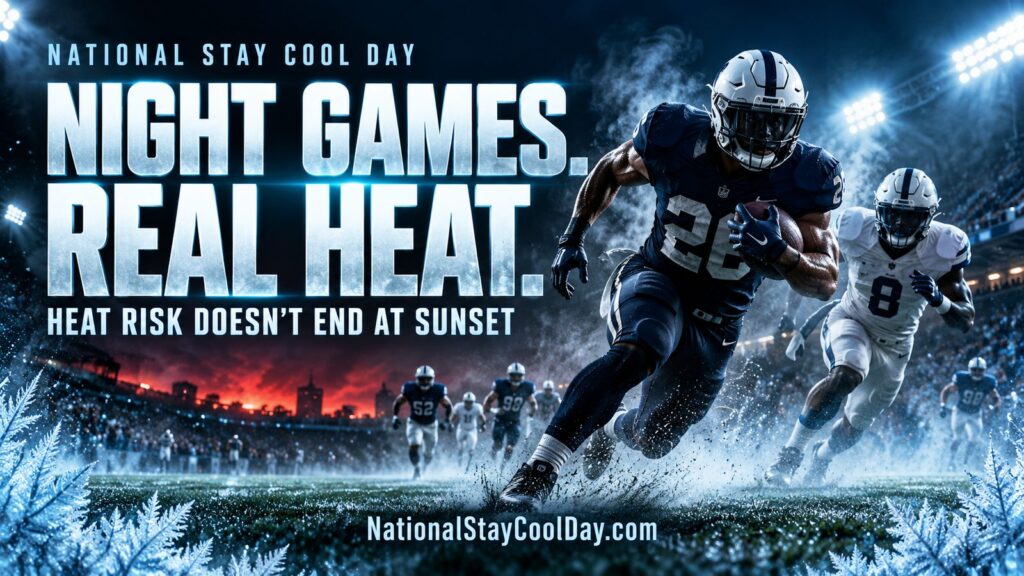
A 7:30 kickoff feels like relief after a hot afternoon. The sun is going down, the stadium lights are on and the thermometer has dropped a few degrees. Coaches relax the break schedule, staff stop watching as closely and the cooling tub stays in the shed. That is exactly how heat stroke catches a team off guard.
Evening games and practices still carry real heat risk. This guide explains why, and what to do differently when the game starts after dark.
Why the Heat Does Not Leave With the Sun
The field holds the afternoon’s heat
A field that sat in full sun all afternoon is still giving off heat when the lights come on. Synthetic turf runs especially hot. A systematic review of 23 studies found synthetic grass surfaces were consistently hotter than natural grass, with surface temperatures about 17°F to 61°F higher and air just above the surface about 1°F to 2°F warmer. Athletes warming up, stretching and playing on that surface take in heat from below while the air starts to cool around them.
Humidity climbs as the air cools
As air temperature drops in the evening, the relative humidity rises. The body cools mostly by evaporating sweat, and the National Weather Service explains that the wet-bulb reading in WBGT mirrors exactly that process. Moist evening air slows evaporation, so a lower air temperature does not mean the body sheds heat more easily. Read why humid days make practice more dangerous than hot dry days.
Warm nights add up
The National Weather Service factors overnight temperatures into its heat risk forecasts, because warm overnight lows keep adding heat stress into the next day. The National Athletic Trainers’ Association (NATA) states that the effects of heat are cumulative, and that high heat stress the previous day is one of the best predictors of heat illness the following day.
The athlete brings the day’s heat to the game
Night game athletes do not start the evening fresh. They have spent the day in hot classrooms, at summer jobs, at earlier practices, at a tournament game earlier in the day or simply outside. An athlete who arrives short on fluids and already heat-stressed is at higher risk from the first snap.
Why Heat Illness Gets Missed at Night
- “It’s cooler” becomes the plan. Staff decide the danger has passed and skip the heat reading, shorten breaks or leave the tub unfilled.
- Bad light hides the signs. Stumbling, confusion and pale or flushed skin are harder to spot on a dim sideline or at the far end of the field.
- Fewer people are watching. Night practices and late games often have less medical coverage than afternoon events.
- The athlete pushes through. Players who feel the evening is cooler ignore early warning signs and keep going.
- Collapse after the game gets missed. Heat stroke also happens after activity ends, in the locker room, the parking lot or on the bus.
Take the Reading at Game Time
Air temperature alone does not measure heat stress. WBGT combines air temperature, humidity, wind and sun, and the National Weather Service forecasts it up to 7 days in advance. Take a reading on site right before warm-ups, and take it again during the game if conditions change. Set breaks and activity by that number, not by the clock or the sky. Read WBGT for schools for how to take a reading that counts.
A Night Game Heat Plan
- Check the day, not just the evening. Look at the afternoon heat, last night’s low and the forecast for game time.
- Take an on-site heat reading before warm-ups and set breaks to match it. Post your levels on a Heat Rules Card.
- Set up the cooling tub before warm-ups, with water in it and ice beside it, exactly as you would for an afternoon game.
- Light the cooling station. Put the tub where it is lit and easy to reach, with a flashlight or portable light on hand.
- Keep fluids open. Athletes drink before arrival, during warm-ups and at every break.
- Cool the warm-up. Keep pregame work short and limit extra gear until it is needed.
- Watch every athlete through the final whistle and after, including the walk to the locker room and the bus.
- Keep the emergency plan in force. Roles, radios and the EMS route stay the same after dark. Write them into your plan with the free Emergency Action Plan Builder.
Tournament Nights and Late Games
Tournaments often push games late into the evening after a full day of play. Every earlier game adds to the heat load an athlete carries into the night. Rest, fluids, shade and the cooling tub stay in place until the last game ends. Read tournament heat safety on multi-game days.
Know the Signs
Confusion, stumbling, odd behavior, irritability or collapse during or after activity in the heat is heat stroke until proven otherwise, at any hour and even if the athlete is still sweating.
If It Is Heat Stroke
- Call 911 and start cooling at the same time.
- Put the athlete in a tub of ice water, covering as much of the body as possible, with the head supported above the water.
- Remove anything you can quickly but don’t delay cooling because of gear removal.
- Keep up ice agitation the whole time.
- Start cooling within 10 minutes and cool to about 102°F within 30 minutes, then transport.
Cold towels and ice packs are not enough. Read why cold towels, ice packs and fans don’t treat heat stroke.
Frequently Asked Questions
Is it safe to practice at night to avoid the heat?
Moving practice later lowers sun exposure, and that helps. It does not remove heat risk. Take a heat reading at practice time and keep the full heat plan in place.
Does a cooler evening temperature mean lower WBGT?
Not always. Humidity rises as the air cools, and humidity carries a large share of the WBGT reading. Measure it on site instead of guessing.
Do we need the cooling tub for a night game?
Yes. Heat stroke happens at night. The tub is set up and ready before warm-ups at every hot game, day or night.
Is turf still hot after sunset?
Yes. A field that sat in the sun all day releases that heat into the evening, and synthetic turf runs hotter than natural grass.
National Stay Cool Day Is April 8, 2027
National Stay Cool Day is a free national day for schools and programs to put heat plans in place before the season. Sign your school or program up.
References
- National Athletic Trainers’ Association. Position Statement: Exertional Heat Illnesses. Journal of Athletic Training. 2015;50(9):986-1000. See recommendation 9 and the section on WBGT the previous day and night. pmc.ncbi.nlm.nih.gov/articles/PMC4639891
- The effect of synthetic grass sports surfaces on the thermal environment: a systematic review. 2024. pmc.ncbi.nlm.nih.gov/articles/PMC11272752
- National Weather Service. What is the heat index? weather.gov/safety/heat-index
- National Weather Service. Wet Bulb Globe Temperature. weather.gov/news/211009-WBGT
This article is for education and planning. It does not replace medical advice. Review all medical steps with your team physician or medical director. In an emergency, call 911.