October 25, 2026
Why Humid Days Make Practice More Dangerous Than Hot Dry Days
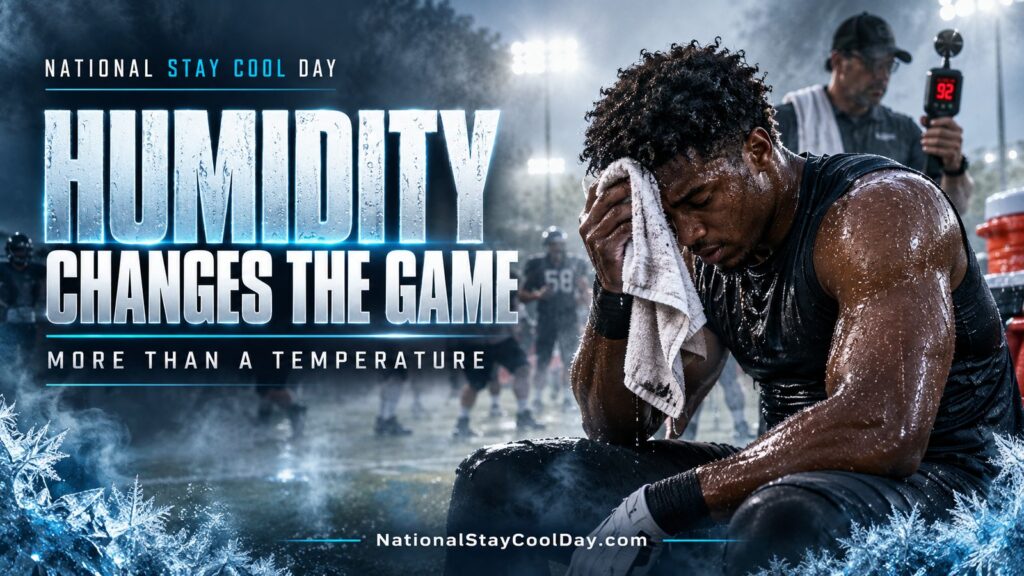
A 100-degree day in the desert and a 90-degree day on a muggy afternoon in the Southeast do not put the same stress on an athlete. The muggy day is often the more dangerous one. The reason is simple: the body cools itself mainly by evaporating sweat, and humid air stops sweat from evaporating.
This guide explains why humidity raises the danger, why the air temperature alone is the wrong number for practice calls, and what coaches do on humid days.
How the Body Cools Itself
Working muscles produce a large amount of heat. To keep core temperature in a safe range, the body moves blood to the skin and sweats. When sweat evaporates, it carries heat away. The National Athletic Trainers’ Association (NATA) identifies evaporation as the most efficient way the body gets rid of heat during exercise.
Sweat that drips off or soaks into a shirt does not cool much. Cooling comes from sweat turning into vapor on the skin.
What Humidity Does to That System
Humidity is the amount of water vapor already in the air. When the air is already full of moisture, sweat has nowhere to go. NATA states that evaporative cooling drops off rapidly when humidity is high.
NATA also explains the worst case. When the air is hotter than the skin, the body absorbs heat from its surroundings and depends entirely on evaporation to cool down. When humidity is also high, evaporative heat loss is severely reduced, core temperature rises quickly, and the risk of exertional heat stroke becomes extreme.
That is why athletes on humid days look drenched but keep heating up. Heavy sweat on a humid day is a sign the cooling system is working hard and losing, not a sign the athlete is fine.
The Research: Humid Heat Is Harder on the Body
A 2020 study in the Journal of Athletic Training used 15 years of hourly weather data from 217 stations across the contiguous United States. It compared hot-dry conditions, common in the West, with warm-humid conditions, common in the East. Even at the same WBGT reading, athletes in warm-humid conditions had less ability to shed heat than athletes in hot-dry conditions. The gap grew as the heat rose and as athletes moved faster.
The takeaway for coaches: humidity is not a footnote to the temperature. It is one of the main drivers of heat stress.
Why Air Temperature Alone Misleads
The thermometer on a phone or a bank sign measures air temperature in the shade. It leaves out humidity, sun and wind. Two better tools exist.
Heat index
The National Weather Service (NWS) heat index combines air temperature and humidity to show how hot it feels. NWS gives this example: at 96°F with 65% relative humidity, the heat index is 121°F. Humidity also works the other way. At 100°F with 15% relative humidity, the heat index is 96°F, lower than the air temperature. Heat index values are calculated for shade and light wind. NWS notes that full sun adds up to 15°F.
Wet bulb globe temperature (WBGT)
WBGT combines air temperature, humidity, wind and sun, and NWS identifies it as an effective indicator of heat stress for athletes and outdoor workers. Its wet bulb thermometer is covered in a wet cloth and is cooled by evaporation, the same way sweat cools skin. When the air is humid, the wet bulb stays warm and the WBGT reading climbs. That is the right tool for practice decisions. Read WBGT for schools: how to use wet bulb globe temperature to make practice calls.
| Measure | What it includes | Best use |
|---|---|---|
| Air temperature | Air temperature in the shade only | Not enough for practice decisions |
| Heat index | Air temperature and humidity, in the shade | A quick warning for the public; add caution for full sun |
| WBGT | Air temperature, humidity, wind and sun | Practice and game decisions for athletes |
What Coaches Do on Humid Days
- Use WBGT, not the forecast high. Take an on-site reading before practice and again during practice, on the surface where athletes play. Follow your state association’s chart. NWS publishes WBGT forecasts up to 7 days ahead for planning.
- Cut intensity and add breaks. NATA calls for work-to-rest ratios matched to the conditions and the intensity of the activity, with breaks in shade or a cooling zone and enough time for every athlete to drink.
- Take gear off. Helmets, pads and heavy uniforms trap heat and block evaporation. NATA notes that equipment that does not let water vapor pass raises heat illness risk. Let athletes remove helmets at breaks and drop to lighter gear as the reading rises.
- Move practice. Schedule early morning or evening sessions. Humidity is often highest in the early morning, so check the WBGT at the time you plan to practice, not only the afternoon high.
- Watch the first humid days closely. NATA notes that heat guidelines should match the region and that the first 2 to 3 weeks of a season carry the greatest risk. A sudden jump in humidity, or a trip to a more humid region for a tournament or camp, calls for lighter work and more breaks.
- Keep fluids open. NATA calls for free access to fluids at all times, along with sodium-containing drinks and foods to replace what is lost in sweat. Heavy sweating on humid days drains fluids fast.
- Post a Heat Rules Card. Put your WBGT levels, break rules and emergency steps where every coach sees them. Make one with the free Heat Rules Card.
- Have the tub ready. Humid days are tub days. Set up the cold-water immersion tub before practice starts. Read why every practice and event needs a tub on site, and build your site plan with the free Emergency Action Plan Builder.
Indoor Humidity Counts Too
Gyms, wrestling rooms and weight rooms without air conditioning trap heat and moisture from a room full of athletes. Closed doors and poor airflow make it worse. Measure conditions inside the same way you measure them outside, and use the same break and fluid rules.
Know the Signs and the Response
Confusion, stumbling, odd behavior, irritability or collapse during or after activity in the heat is heat stroke until proven otherwise, even if the athlete is still sweating.
- Call 911 and start cooling at the same time.
- Put the athlete in a tub of ice water, covering as much of the body as possible, with the head supported above the water.
- Remove anything you can quickly but don’t delay cooling because of gear removal.
- Keep up ice agitation the whole time.
- Start cooling within 10 minutes and cool to about 102°F within 30 minutes, then transport.
On a humid day, fanning works even less well, because it depends on evaporation too, and cold towels and ice packs cool only small areas of skin. Cold-water immersion cools by direct contact with cold water over most of the body, which humidity does not slow. Read why cold towels, ice packs and fans don’t treat heat stroke.
Frequently Asked Questions
Is humid heat really more dangerous than dry heat?
Yes. Humidity blocks the evaporation of sweat, the body’s main way to cool itself during exercise. Research shows athletes lose less heat in warm-humid conditions than in hot-dry conditions, even at the same WBGT reading.
Is the heat index good enough for practice decisions?
No. The heat index leaves out sun and wind and is calculated for shade. WBGT includes air temperature, humidity, wind and sun, and is the measure built for athletes.
Does a sweaty athlete mean the body is cooling well?
No. On humid days sweat cannot evaporate, so heavy sweating comes with less cooling. An athlete with heat stroke can still be sweating.
Do fans help on a humid day?
Fans move air, but they rely on evaporation, which humidity limits. They are not a treatment for heat stroke. Cold-water immersion is.
What about a hot, dry day?
Dry heat is still dangerous, especially in full sun and with hard work. Use WBGT every day it is warm, whatever the humidity.
National Stay Cool Day Is April 8, 2027
National Stay Cool Day is a free national day for schools and programs to put heat plans in place before the hot season. Sign your school or program up.
References
- National Athletic Trainers’ Association. Position Statement: Exertional Heat Illnesses. Journal of Athletic Training. 2015;50(9):986-1000. See recommendations 2, 4, 10, 12, the sections on evaporation, environmental conditions and barriers to evaporative heat loss, and Table 6. pmc.ncbi.nlm.nih.gov/articles/PMC4639891
- Variations in athlete heat-loss potential between hot-dry and warm-humid environments at equivalent wet-bulb globe temperature thresholds. Journal of Athletic Training. 2020;55(11):1190-1198. pubmed.ncbi.nlm.nih.gov/33112954
- National Weather Service. Heat Index and Wet Bulb Globe Temperature. weather.gov/safety/heat-index
- National Weather Service Amarillo. What is the heat index? weather.gov/ama/heatindex
- National Weather Service. Wet Bulb Globe Temperature: How and when to use it. weather.gov/news/211009-WBGT
This article is for education and planning. It does not replace medical advice. Review all medical steps with your team physician or medical director. In an emergency, call 911.