
October 20, 2026
Return to Play After Exertional Heat Stroke: What Coaches and Parents Need to Know
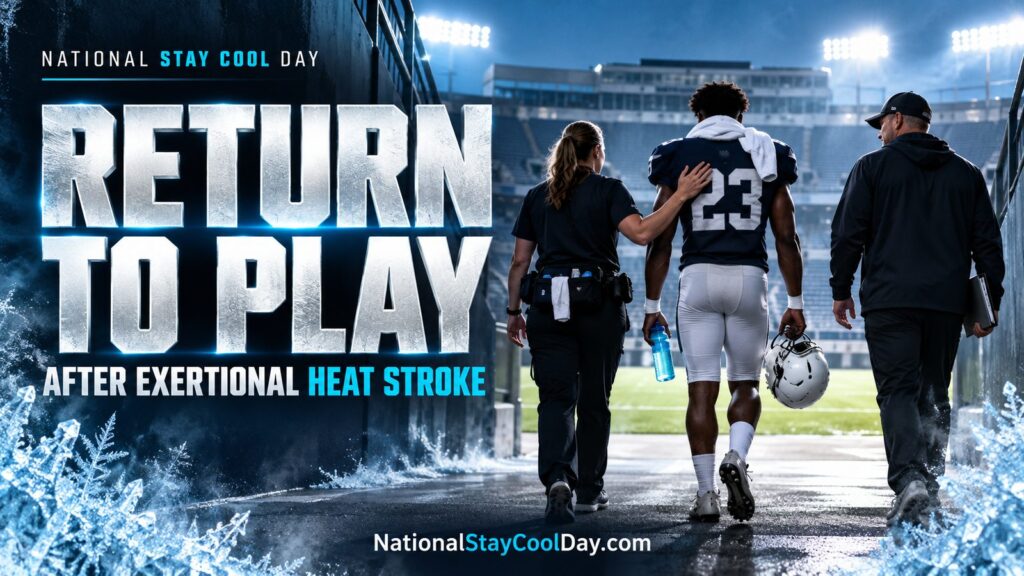
An athlete who survives exertional heat stroke wants to get back on the field, and the family wants to know when that is safe. The answer depends on how fast cooling started, what the follow-up tests show and how the athlete handles a gradual return. This guide walks coaches, parents and athletes through the published return-to-play process, step by step.
Recovery Starts With the Cooling
The single biggest factor in recovery happens in the first 30 minutes. The National Athletic Trainers’ Association (NATA) position statement on exertional heat illnesses explains that many athletes who are cooled effectively go home the same day and resume modified activity within about a month with a physician’s clearance. When treatment is delayed past 30 minutes, complications can last for months or years.
The American College of Sports Medicine’s 2023 expert consensus statement ties recovery to how long the athlete stayed severely overheated. That is why the standard is to start cooling within 10 minutes and cool to about 102°F within 30 minutes, then transport. Exertional heat stroke is one of the most survivable emergencies in sports when that happens, and fast cooling also sets up a faster, cleaner return.
The Return-to-Play Steps
NATA lays out the process. Every step needs the athletic trainer and the physician working together.
| Step | What happens | Who decides |
|---|---|---|
| 1. Rest | A rest period of 7 to 21 days after the event | Physician |
| 2. Symptoms gone | The athlete has no ongoing symptoms | Physician and athletic trainer |
| 3. Normal blood work | Kidney and liver panels, electrolytes and muscle enzymes back to normal | Physician |
| 4. Physician clearance | Written clearance to begin activity | Physician |
| 5. Graded activity in a cool setting | Low intensity to high intensity, short to longer sessions, in a temperate environment, with equipment added gradually | Athletic trainer, supervising |
| 6. Graded heat acclimatization | A gradual return to exercise in the heat, watching for any signs of heat illness | Athletic trainer, supervising |
| 7. Full return | Full practice and competition once the athlete handles heat and intensity without problems | Physician and athletic trainer |
During steps 5 and 6, NATA calls for monitoring rectal temperature and heart rate. If the athlete has any negative symptoms, the progression slows, pauses or stops.
Heat Tolerance Testing
NATA notes that few evidence-based tools exist to confirm the body’s temperature control has recovered, so clinicians rely on clinical cues: ongoing symptoms, how the athlete responds to a standard exercise heat tolerance test, how they handle increasing exercise demands and whether they acclimatize to heat normally. A poor result on a heat tolerance test means the athlete does not increase activity at that point. The U.S. and Israeli militaries use structured return-to-duty programs built on monitored heat exposure, and NATA points to them as a model.
Find the Cause
NATA’s guidance stresses identifying why the heat stroke happened, so it does not happen again. Review the day with the athletic trainer:
- Was the athlete acclimatized, or was it early in the season or after a break?
- Was the athlete sick, short on sleep or behind on fluids?
- What were the heat conditions, and were activity limits followed?
- Was the athlete wearing full equipment or doing conditioning drills?
- Was the athlete taking any supplements or medications?
Fix what you find before the athlete returns to the heat. NATA’s sample preseason physical questions ask about past heat stroke, complications and how long return took, so record the details now.
Heat Exhaustion and Other Heat Illnesses
| Condition | Return guidance (NATA) |
|---|---|
| Heat cramps | Monitor until signs and symptoms are gone |
| Heat syncope (fainting) | Monitor until signs and symptoms are gone |
| Heat exhaustion | No same-day return. Recovery often occurs within 24 hours |
| Exertional heat stroke | Rest, normal blood work, physician clearance and a supervised, graded return as described above |
For Parents
- Keep copies of hospital records, blood work and the physician’s clearance.
- Ask the athletic trainer for the written return plan and who supervises each stage.
- Tell every future coach and athletic trainer about the heat stroke, including on preseason physical forms.
- Watch for warning signs at home after workouts: unusual fatigue, headache, dizziness or trouble with heat.
- Do not let your athlete skip steps to make a big game.
For Coaches
- Let the athletic trainer and physician set the pace. Do not schedule the athlete for full practice until they clear each stage.
- Use the athlete’s return as a reason to review your heat plan, your cooling tub setup and your emergency action plan. Build or update it with the free Emergency Action Plan Builder.
- Follow an acclimatization schedule for the returning athlete. The free Acclimatization Schedule is a starting point.
- Make sure a cold-water immersion tub is at every practice. Read why every practice and event needs a tub on site.
Frequently Asked Questions
How long until an athlete can play after heat stroke?
It depends on the athlete. NATA describes a rest period of 7 to 21 days, then normal blood work and physician clearance before a gradual, supervised return. Athletes who were cooled quickly often resume modified activity within about a month.
Who clears an athlete to return?
A physician, working with the athletic trainer who supervises the gradual return.
Is an athlete who had heat stroke at higher risk later?
NATA notes that an athlete who has had heat stroke can have reduced heat tolerance even after clearance, which is why the return includes a graded heat acclimatization and close monitoring.
Can an athlete with heat exhaustion play later the same day?
No. NATA states that same-day return after heat exhaustion is not recommended.
What if cooling was delayed?
Recovery can take longer and involve more testing. Follow the physician’s plan closely. Delayed cooling is the reason every program needs a tub on site. Read why cold towels, ice packs and fans don’t treat heat stroke.
Prevention Is the Best Return Plan
The best return is one that never has to happen. Learn the warning signs of heat stroke, ask the questions every parent should ask, and bring your program to National Stay Cool Day on April 8, 2027. Sign up here.
References
- National Athletic Trainers’ Association. Position Statement: Exertional Heat Illnesses. Journal of Athletic Training. 2015;50(9):986-1000. pmc.ncbi.nlm.nih.gov/articles/PMC4639891
- American College of Sports Medicine. Expert Consensus Statement on Exertional Heat Illness: Recognition, Management, and Return to Activity. Current Sports Medicine Reports. 2023;22(4):134-149. journals.lww.com/acsm-csmr
This article is for education and planning. It does not replace medical advice. Return-to-play decisions belong to the athlete’s physician and athletic trainer. In an emergency, call 911.