
November 21, 2026
Student Managers and Team Helpers: Your Job When Heat Turns Dangerous
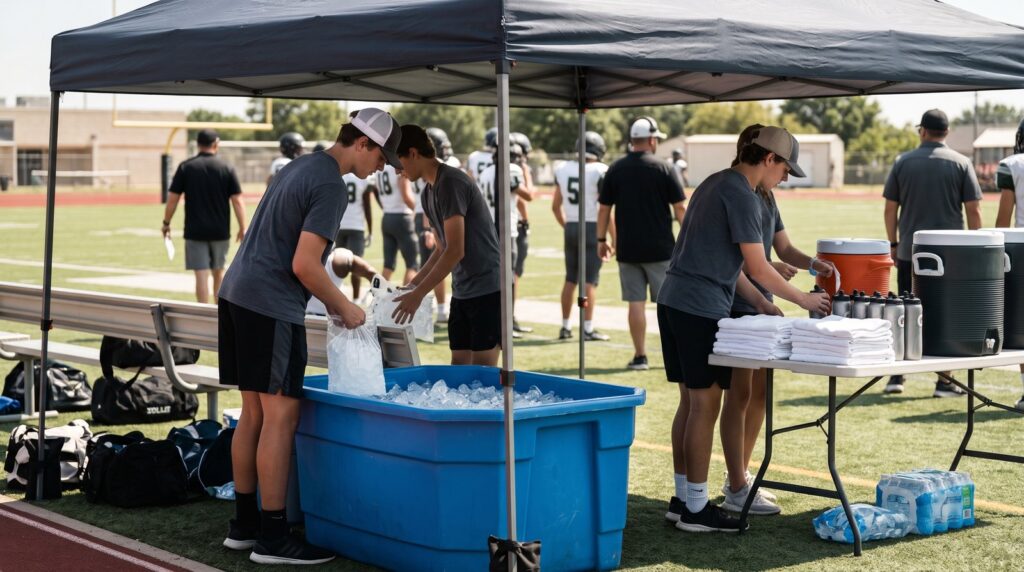
Student managers, student athletic trainers and team helpers are at almost every practice. They fill the water, carry the coolers, set out the cones and know where everything is. On a hot day, that makes them some of the most useful people on the field when a player goes down.
Exertional heat stroke is 100% survivable when the athlete is cooled fast, on site. Coaches and medical staff lead that response, but they can’t do it alone. This guide is for the students who help them, and for the coaches who want those students ready.
Why Your Job Matters on Hot Days
When an athlete collapses, several things have to happen at once. Someone calls 911. Someone starts cooling. Someone meets the ambulance. Someone keeps the rest of the team out of the way. If the adults are stretched thin, a trained student who knows the plan can fill a gap and save minutes.
You are not there to diagnose anyone. Your job is to know the plan, have the gear ready and do your assigned part when an adult calls for it.
Before the Season
- Ask your coach or athletic trainer for a copy of the emergency action plan, and read it. If your team doesn’t have one yet, our free emergency action plan builder is a good place for the adults to start.
- Find out what your role is if an athlete goes down. Write it on your phone or a card in the kit.
- Learn where the cooling tub, ice, hose and water are kept at every field, gym and away site you’ll be at.
- Learn the address of each practice site and which gate or door an ambulance would use.
- Take part in the emergency drill. If your team doesn’t run one, ask if it can.
Before Every Hot Practice or Game
- Fill the cold-water immersion tub with ice and water and set it close to where the team is working, in shade if you can. Our cooling station checklist lists what should be there.
- Bring extra ice. A tub needs a lot of it, and it melts fast in the heat.
- Set out water where players can reach it during every break, not only at the end of practice.
- Make sure the path from the field to the tub is clear.
- Know who the adult in charge is today and how to reach them fast.
During Practice
- Keep water filled and moving. Breaks only help if the water is there when players get to it.
- Watch players, not just the drills. You often see things from the sideline that coaches miss.
- If a player seems off, tell an adult right away. You never get in trouble for speaking up, and it’s better to be wrong than to wait.
- Pay extra attention on the first days of practice, in heavy gear and late in a hard session. Read why the first two weeks matter.
- Take care of yourself too. You’re out in the same heat. Drink water and take shade when you can.
Signs to Tell an Adult About Right Away
The sign that matters most is a change in how the brain is working. Get an adult now if a player:
- seems confused, gives strange answers or doesn’t know where they are
- stumbles, loses balance or can’t keep up
- acts out of character, gets irritable or seems “out of it”
- collapses or has a seizure
They may still be sweating. Sweat does not rule out heat stroke. For the full list, read exertional heat stroke symptoms every coach and parent should know.
If a Player Goes Down
The adult in charge leads. Your job is to do your assigned part fast. The plan should look like this:
- Get an adult to the player. Yell for help if you have to.
- Call 911 and start cooling at the same time. One person calls. Others help with cooling. If you’re told to call, give the address and say an athlete may have heat stroke.
- Cool first, transport second. Cooling should start within 10 minutes. The goal is to bring body temperature down to about 102°F within 30 minutes.
- Use cold-water immersion with ice agitation. Help get the player into the tub and keep the ice and water moving around them. Bring more ice if it’s running low.
- Remove anything you can quickly but don’t delay cooling because of gear removal.
- Meet the ambulance at the gate or door and lead the crew straight to the player.
- Keep the team back so the adults have room to work.
Why the rush: at 104°F, the body loses its ability to regulate its own temperature. Cold towels and ice packs are not enough. Read why cold towels don’t treat heat stroke and cool first, transport second.
For Coaches and Athletic Trainers
Give your student helpers a real role in the emergency action plan, walk them through it before the season and include them in the drill. Make sure every student knows they can stop and get an adult any time something looks wrong. For more on building the team side of this, see our guide for athletes on looking out for teammates.
Bring Your Team Into National Stay Cool Day
National Stay Cool Day is April 8, 2027. Student managers, student trainers and whole teams can take part. Here’s how schools and programs can sign up.