October 13, 2026
Marching Band Heat Safety: What Directors and Parents Need to Know
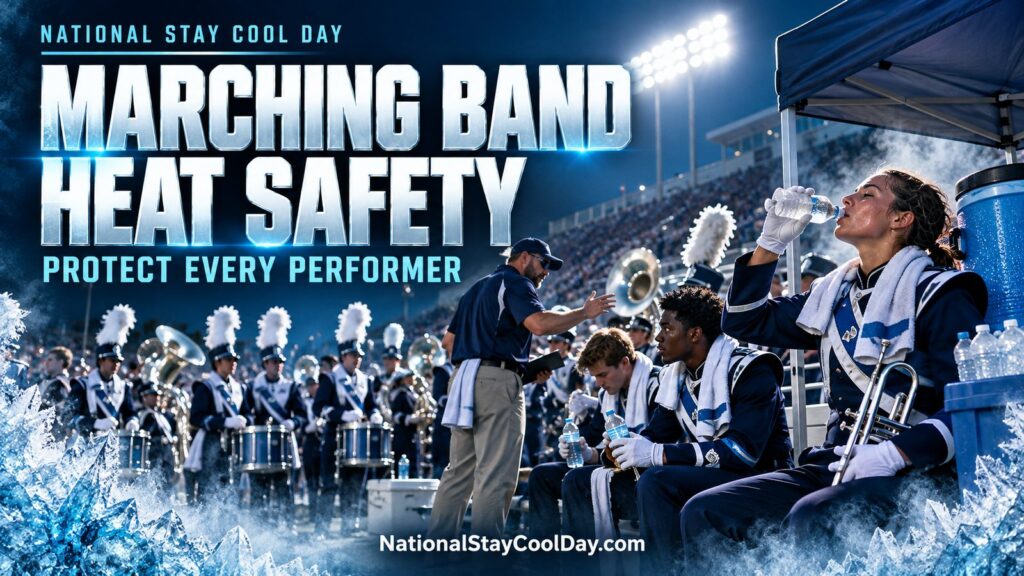
Marching band is a physical activity. Members rehearse for hours on turf, track and parking lots in late summer, carry instruments and perform in heavy uniforms. Band members are often outside the athletic department’s screening and heat planning, even though the band is on the same field in the same heat.
This guide covers what the research shows about heat illness in marching band, the risks that are specific to band, and a practical heat plan for directors, boosters and parents.
What the Research Shows
Researchers have started measuring heat strain in marching band, and the findings are consistent.
- Core temperatures run high. A 2021 study in the Journal of Athletic Training tracked core temperature in college band members during rehearsals and football games. The average peak was 39.1°C (about 102.4°F) at games, and the highest reading was 41.2°C (about 106.2°F), during a game. Game days lasted more than four hours on average. Higher peak temperatures tracked with higher wet bulb globe temperature (WBGT).
- Members arrive behind on fluids. In the same study, members reported to games dehydrated 63.6% of the time, and fluid intake did not keep up with sweat losses.
- Heat illness is common. In a 2024 survey of 1,207 college marching band members, 50.6% reported a past exertional heat illness. Most were heat exhaustion, and 31 members reported heat stroke.
- High school bands are most affected. A 2021 case series in the International Journal of Biometeorology found 34 events and at least 393 heat illnesses among marching bands in the U.S. from 1990 to 2020. About 88% involved high school bands. About 32% happened at rehearsal, 29% at parades, 21% at competitions and 15% at performances. Most occurred when the weather was unusually hot for the area.
Risks That Are Specific to Band
Uniforms
Full marching uniforms trap heat. A 2024 heat-balance study of a 2018 Independence Day parade that produced more than 50 heat illnesses found that full band uniforms cut evaporative cooling by 50%. The authors recommend summer uniforms when hot conditions are expected.
Long blocks without breaks
In that same parade, members marched about 4 kilometers over several hours without breaks, and the model showed their bodies could no longer shed heat as fast as they made it. Long rehearsal blocks and parade routes need scheduled breaks in shade with water.
Hot surfaces
Bands rehearse on tracks, turf and pavement. A 2017 study in the Journal of Athletic Training found WBGT on black tennis courts, black and red tracks and volleyball sand ran higher than National Weather Service estimates, and it varied widely from one surface to the next. The authors recommend measuring WBGT on each surface where people are active. A systematic review in 2024 found that air and surface temperatures run higher on synthetic turf than on natural grass.
No preseason screening and no acclimatization plan
Band members are often not required to have a preparticipation physical. The 2024 college survey linked past heat illness to factors that a physical would flag, including certain medications and medical conditions, and the authors call for preparticipation exams. Band camp also tends to start with long, full days. Athletes get a gradual acclimatization period at the start of a season. Band members need one too.
Travel to cooler or hotter places
Bands travel to parades, competitions and bowl games. The parade study also flags a lack of acclimatization in members who came from cooler regions. A band from a mild climate performing in a hot, humid city is at higher risk than the local bands.
A Heat Plan for Band
- Check WBGT on site before and during every outdoor rehearsal, on the surface where the band is working. Use your state association’s activity chart if your school applies it to band, or adopt one with your athletic trainer.
- Build in acclimatization. Start band camp with shorter outdoor blocks and add time over the first two weeks. Use the free Acclimatization Schedule as a starting point.
- Schedule breaks. Plan rest breaks in shade with unlimited water, and add more as WBGT rises. Let members remove shakos, jackets and gloves during breaks.
- Use summer uniforms or lighter performance wear in hot conditions, and keep full uniforms on for the shortest time possible on game days.
- Move rehearsals to early morning or evening when the forecast is hot. Check the National Weather Service WBGT forecast a week out.
- Hydrate before arrival. Remind members and families that hydration starts the night before. The research shows members often arrive already behind.
- Bring the band into the athletic training plan. Ask your athletic trainer to cover band rehearsals and game days, and add the band to your school’s emergency action plan.
- Set up a cold-water immersion tub wherever the band rehearses or performs in the heat. A basic 100-gallon stock tank costs about $150. See why every practice and event needs a cold-water immersion tub on site.
- Plan parades and trips. Ask organizers where shade, water and medical help will be along the route, and plan for the climate at the destination.
- Train staff and section leaders to spot heat illness and to call for help fast.
Know the Signs
Heat exhaustion brings heavy sweating, weakness, dizziness, headache and nausea. The member stays alert. Move to shade, loosen or remove the uniform, cool with fans or ice towels, and give fluids if the member can drink.
Heat stroke adds changes in how the brain works: confusion, stumbling, odd behavior, collapse or unresponsiveness. A member can still be sweating. Treat it as an emergency:
- Call 911 and start cooling at the same time.
- Put the member in a tub of ice water, covering as much of the body as possible, with the head supported above the water.
- Remove anything you can quickly but don’t delay cooling because of gear removal.
- Keep up ice agitation the whole time.
- Start cooling within 10 minutes and cool to about 102°F within 30 minutes, then transport.
Read more in Exertional Heat Stroke Symptoms Every Coach and Parent Should Know and Cold Water Immersion for Heat Stroke in Schools.
Color Guard, Cheer and Dance
The same plan applies to every group that performs outdoors in the heat. Color guard spins equipment through full rehearsals. Cheer and dance teams work the sideline for entire games, often in direct sun on turf or track. Give them on-site WBGT checks, shade and water breaks, a place in the emergency action plan and access to the cooling tub.
Frequently Asked Questions
Is marching band really at risk for heat stroke?
Yes. Research has measured core temperatures above 106°F in college band members during a game, and a survey of more than 1,200 college members found that half had experienced a heat illness.
Do band members need a physical?
Researchers studying band heat illness recommend preparticipation exams to find medical conditions and medications that raise heat risk. Ask your school about its policy.
Should band follow the athletic department’s heat policy?
Band faces the same heat on the same fields. Ask whether your school’s athletic heat policy covers band. If it does not, ask the athletic director and athletic trainer to extend it.
What should a band parent pack?
A large refillable water bottle, a sports drink, a light snack, sunscreen and light clothing for rehearsals. Make sure your child eats and drinks before arriving.
Who decides when rehearsal moves indoors?
Name one person, usually the director working with the athletic trainer, who checks WBGT and has the authority to change or stop rehearsal. Put that name on your Heat Rules Card.
Bring the Band to National Stay Cool Day
National Stay Cool Day on April 8, 2027 is for every student who performs or competes outdoors, band included. Build your plan with the free Emergency Action Plan Builder and sign your school up.
References
- Core body temperatures in collegiate marching band artists during rehearsals and performances. Journal of Athletic Training. 2021;56(3):302-310. pmc.ncbi.nlm.nih.gov/articles/PMC8010928
- Self-reported exertional heat illness and risk factors among collegiate marching band artists. Sports Medicine and Health Science. 2025;7(2):132-142. pmc.ncbi.nlm.nih.gov/articles/PMC11726051
- Exertional heat illnesses in marching band artists: a case series. International Journal of Biometeorology. 2021;65(12):2181-2188. pubmed.ncbi.nlm.nih.gov/34424411
- Parade safety and planning: a heat balance case study of marching band artists. Journal of Occupational and Environmental Hygiene. 2024;21(8):591-601. pubmed.ncbi.nlm.nih.gov/39008819
- The heat strain of various athletic surfaces: a comparison between observed and modeled wet-bulb globe temperatures. Journal of Athletic Training. 2017;52(11):1056-1064. pmc.ncbi.nlm.nih.gov/articles/PMC5737042
- The effect of synthetic grass sports surfaces on the thermal environment: a systematic review. International Journal of Biometeorology. 2024;68(7):1235-1252. pmc.ncbi.nlm.nih.gov/articles/PMC11272752
- National Athletic Trainers’ Association. Position Statement: Exertional Heat Illnesses. Journal of Athletic Training. 2015;50(9):986-1000. pmc.ncbi.nlm.nih.gov/articles/PMC4639891
This article is for education and planning. It does not replace medical advice. Review all medical steps with your team physician or medical director. In an emergency, call 911.