August 9, 2026
July 2026: The Hottest Month in U.S. History — What You Need to Know”

July 2026 shattered records as the hottest month in U.S. history, with an average temperature of 76.9°F across the contiguous United States — a staggering 3.3°F above the 20th-century average, according to the National Oceanic and Atmospheric Administration . Three major heat domes struck between late June and early August, with the Independence Day heat wave (June 28–July 5) placing nearly 180 million people under major or extreme heat risk as classified by the National Weather Service . That single event caused at least 44 heat-related fatalities across five states: 29 in New Jersey, 7 in Pennsylvania, 4 in Illinois, 3 in New York, and one in Mississippi .
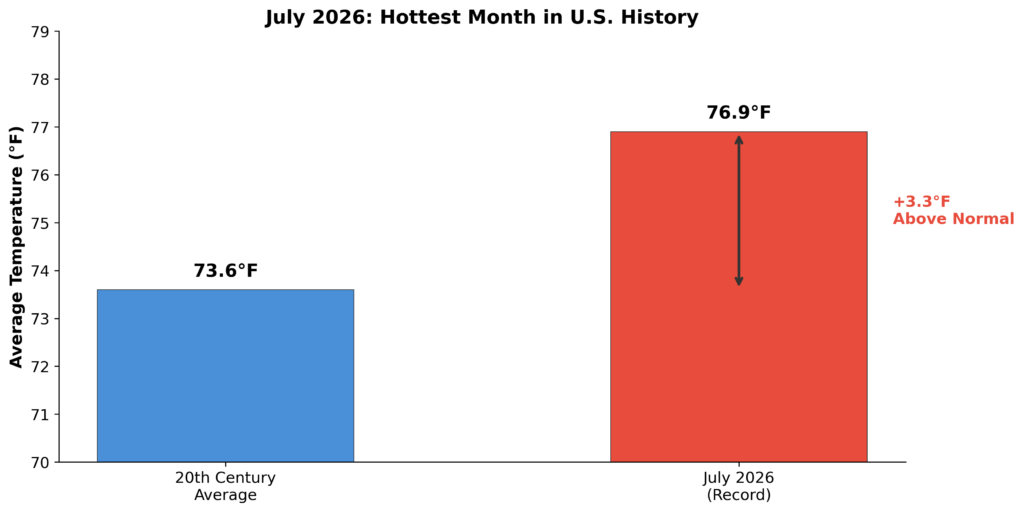
Chart Explanation: This chart compares the July 2026 average U.S. temperature (76.9°F) against the 20th-century average (73.6°F), illustrating the record-breaking 3.3°F anomaly that made it the hottest month in U.S. history .
The heat did not relent after July. As of September 2026, the southern Plains and Mississippi Valley continued facing “widespread Major to Extreme HeatRisk” according to the National Weather Service’s Weather Prediction Center . Cities responded with emergency measures — New York City activated COOL vans, expanded cooling centers, added 150 outreach volunteers, and created pop-up cooling stations for outdoor workers . Austin, Texas held citywide “Keep Austin Cool Day” events with cooling center education .
The scale of 2026’s heat crisis underscores why nationalstaycoolday.com exists. Government agencies like NOAA track the data and the CDC issues clinical guidance, but neither translates the crisis into the kind of accessible, community-level action plan that ordinary Americans need. Understanding that July 2026 was not an anomaly but part of an accelerating trend — with heat domes arriving earlier, lasting longer, and covering more territory — is the first step toward building personal and community resilience. Every reader who checks on an elderly neighbor, pre-hydrates before an outdoor event, or locates their nearest cooling center is part of the solution.