
October 27, 2026
Cold Water Immersion for Heat Stroke in Schools: Setup, Response Protocol, and Student-Athlete Safety
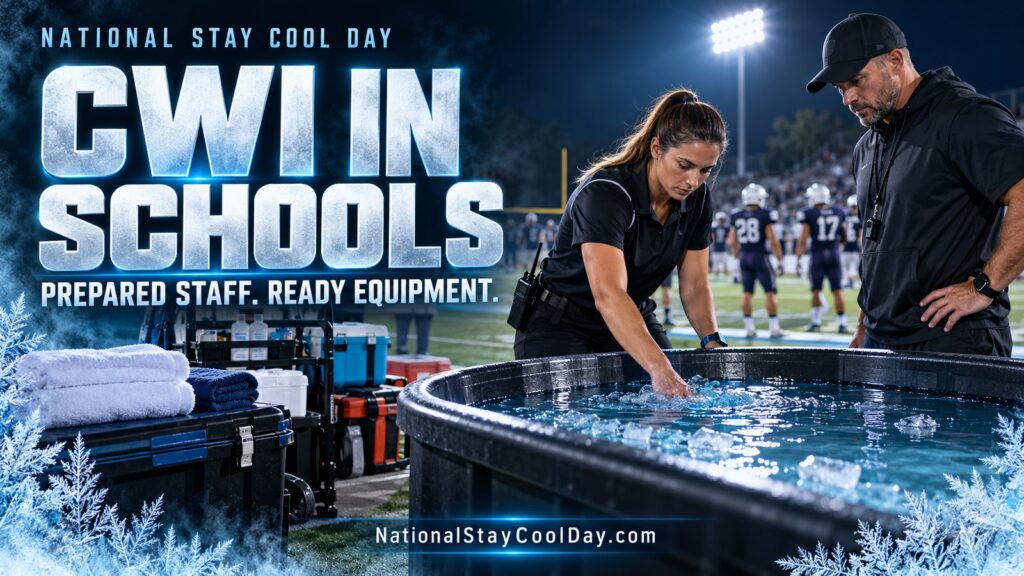
This page contains emergency clinical guidance. The protocols here draw on published guidance from the National Athletic Trainers’ Association (NATA), the Inter-Association Task Force for secondary schools, the Society of Critical Care Medicine (SCCM), the American College of Sports Medicine (ACSM), and the prehospital consensus statement on exertional heat stroke summarized by the National Association of EMS Physicians (NAEMSP). This content is intended for trained athletic staff and school administrators. It does not replace physician oversight, institutional standing orders, or site-specific emergency action plans. Always work with your supervising physician to implement any protocol.
Exertional heat stroke (EHS) is one of the leading causes of preventable death in high school athletics. It is also one of the most survivable emergencies in sports medicine when cooling starts right away, which means the right equipment on site and a protocol staff have practiced.
The CDC estimated that U.S. high school athletes have about 9,000 heat illnesses a year that cost them at least a day of practice or play, based on 2005-2009 surveillance data. The National Center for Catastrophic Sport Injury Research (NCCSIR) 2025 annual football survey counts 53 high school football players who have died from exertional heat stroke since 1996, and describes these deaths as preventable with proper precautions, early recognition, and emergency management. The ACSM Expert Consensus Statement on Exertional Heat Illness (2023), citing NCCSIR data, puts EHS deaths in athletes at about three a year since 1995, mainly in high school football.
The intervention that matters most is cold water immersion (CWI), deployed on the field, before EMS transport.
A study of 274 EHS cases treated with on-site CWI over 18 years at the Falmouth Road Race (DeMartini et al., Med Sci Sports Exerc, 2015) found an average cooling rate of about 0.22°C (0.4°F) per minute. The goal is the same at a school: start cooling within 10 minutes, reach about 102°F within 30, then transport. When cooling is delayed or there is no tub, outcomes get worse.
Most coaches and athletic trainers already know heat stroke is dangerous. What schools usually lack is operational readiness: no tub on the sideline, no ice stockpiled, no written protocol, and no clear role assignments when a student collapses in 95-degree heat on the first day of August practice. In a 2021 survey of 531 high school athletic trainers, about 30% said their school had no written policy for preventing or treating exertional heat illness.
This page addresses that gap. It covers:
How to recognize exertional heat stroke in a student athlete and tell it apart from heat exhaustion
The clinical evidence for cold water immersion as the gold-standard treatment
Step-by-step setup for a school immersion station
A field-ready response protocol with role assignments, including what to do when you’re missing a tub, a thermometer, or an athletic trainer
How to integrate CWI into your school’s written Emergency Action Plan, and what return to play looks like
Frequently asked questions from coaches and administrators
Recognizing Exertional Heat Stroke in Student Athletes
Exertional heat stroke is not simply “feeling overheated.” It is a medical emergency defined by two simultaneous criteria, both of which must be present for a confirmed EHS diagnosis.
Clinical definition (NATA Inter-Association Task Force): Exertional heat stroke is characterized by central nervous system (CNS) dysfunction combined with hyperthermia above about 104–105°F (40.0–40.6°C) at the time of collapse, during or right after intense exercise in the heat. Treat it as EHS at 104°F (40°C) if CNS dysfunction is present.
Warning Signs: What to Watch For
CNS dysfunction is the critical differentiator between EHS and heat exhaustion. A student with heat exhaustion is typically conscious, oriented, and able to communicate. A student with EHS is not.
CNS dysfunction signs include:
Loss of consciousness or unresponsiveness
Altered mental status (confusion, disorientation, combativeness)
Slurred speech or inability to answer simple questions
Staggering, stumbling, or inability to walk in a straight line
Personality change or unusual agitation
Seizure activity
Physical signs that accompany EHS:
Skin that is hot to the touch (may be wet or dry)
Rapid or weak pulse
Rapid breathing
Nausea or vomiting
Flushed appearance
Heat Exhaustion vs. Exertional Heat Stroke
The two conditions are treated differently, and mixing them up costs time.
Feature | Heat Exhaustion | Exertional Heat Stroke |
|---|---|---|
Core temperature | Usually below 104°F (40°C) | Usually above 104°F (40°C) |
Mental status | Normal or mildly altered | Profoundly altered: confusion, combativeness, seizure, or unconsciousness |
Skin | Heavy sweating, pale, cool | May be flushed; sweating does not rule out EHS |
Immediate treatment | Rest, shade, oral fluids, cooling | Cold water immersion; call 911 immediately |
Transport | Monitor; transport if no improvement | Cool to about 102°F (38.9°C) first, then transport |
An athlete who is sweating heavily but alert and coherent is more likely to have heat exhaustion. An athlete who is behaving strangely, stumbling, or unresponsive after exercise in the heat should be treated as an EHS emergency until proven otherwise.
The Temperature Threshold
Do not wait for a thermometer reading to begin cooling. If CNS dysfunction is present during heat-stress conditions, treat for EHS immediately. The NATA position statement on exertional heat illnesses says to cool first and transport second when medical staff are on site, and to start immersion right away. Don’t hold cooling while you wait for a reading.
When a rectal thermistor is available, the diagnostic threshold is a core temperature above 104°F (40°C). Rectal temperature is the only accurate measure of core temperature in an exercising athlete. Oral, axillary, temporal, and tympanic readings are unreliable in this context and should not be used for EHS diagnosis.
Critical note for school settings: Settle rectal temperature before the season: physician-approved standing orders, a signed authorization on file, and whatever parent notice or consent your physician and school counsel require. NATA has a one-page Heat Stroke Treatment Authorization Form (2012) that school administrators, the team physician and the head athletic trainer sign to direct whether athletic trainers take rectal temperatures. It is not a parent consent form.
Why Cold Water Immersion Is the Gold Standard
Cold water immersion is the fastest field cooling method for EHS, and the alternatives are well behind it.
The 2025 Society of Critical Care Medicine Guidelines for the Treatment of Heat Stroke (Barletta et al., Crit Care Med. 2025;53(2):e490–e500) issued a strong recommendation for active cooling over passive cooling, with ice-water or cold-water immersion identified as the method that achieves the fastest cooling rate and shortest time to target temperature.
Cooling Rate Comparison
The SCCM guideline pooled cooling rates from experimental studies (Figure 1 of the guideline). Water temperatures varied across those studies, so the table lists methods only. For your tub, use cold water with ice, as cold as you can get it, per your medical team.
Cooling Method | Cooling Rate (°C/min) |
|---|---|
Ice water immersion (coldest water tested) | 0.178 |
Cold water immersion | 0.154 |
Cool water immersion (warmest water tested) | 0.102 |
Tarp with water | 0.061 |
Cold shower | 0.053 |
Ice sheet cooling | 0.076 |
Commercial ice packs (neck, axilla, groin) | 0.058 |
Evaporative cooling (misting and fanning) | 0.002 |
The takeaway: Ice water immersion cools at roughly 3x the rate of a cold shower and nearly 90 times faster than evaporative cooling. At those rates, an athlete at 107°F can get to about 102°F well within 30 minutes in ice water. Misting and fanning can’t.
The SCCM guideline says to prioritize methods that cool at 0.155°C/min or faster. In its pooled data only ice-water and cold-water immersion come close. Ice packs, wet towels and fans are a bridge while the tub is readied, not the plan.
The 30-Minute Window
Start cooling within 10 minutes and reach about 102°F within 30. NATA (2015) and the SCCM guideline (2025) both set a 30-minute goal. The longer core temperature stays high, the greater the risk of organ damage, lasting neurological injury, and death.
Thirty minutes goes fast. Consider the typical school sequence without a pre-positioned tub: recognize collapse, call for help, locate equipment, find ice, fill a container, transport the athlete. By the time cooling begins, 15 minutes may already be gone.
This is why the tub must already be set up before practice begins during high-risk conditions, not retrieved from storage after a student goes down.
How to Set Up a School Immersion Station
Every school that conducts outdoor athletics during warm-weather months should have a cold water immersion station available at each practice and competition venue during high-risk conditions. The NATA Inter-Association Task Force on Preventing Sudden Death in Secondary School Athletics states explicitly that all schools should have a cold-water immersion tub if a risk of EHS exists.
Equipment Checklist
The station doesn’t require expensive or specialized equipment.
Item | Specification | Notes |
|---|---|---|
Stock tank or large tub | Minimum 100-gallon capacity | Agricultural stock tanks work well and are widely available. Check your state association for any required size |
Ice | 3-4 large bags (20-40 lbs each) | Pre-fill with water; add ice when needed. Keep 3-4 coolers of ice adjacent to the tub |
Water source | Garden hose or large water containers | Needed to half-fill the tub before adding ice |
Rectal thermistor | Digital, with probe | Required for accurate core temperature monitoring; oral/temporal not acceptable |
Waterproof watch or timer | Any | For tracking cooling duration |
Large towel or sheet | For head/neck support | Wrap under the athlete’s axillae to keep head above water |
Ice/wet towels | 2-3 towels | Applied to head and neck while body is submerged |
Waterproof gloves | For staff doing ice agitation | Optional but recommended |
Clipboard with response protocol | Laminated one-page EAP | Posted at or near the station |
Documentation sheet | Waterproof | Record time of collapse, first rectal temperature, readings during immersion, and time cooling ended |
Phone or radio | Charged, with venue address saved | Call 911 and talk with the hospital without leaving the athlete |
Pre-Season and Pre-Practice Setup
Before the season begins:
Identify and purchase the immersion tub and equipment
Establish a water source at each outdoor venue
Confirm ice availability for every high-risk practice day (coordinate with school kitchen or arrange a standing delivery)
Document the station location in the venue-specific EAP
Train all coaches, athletic trainers, and relevant staff on the protocol
On high-risk practice days (preseason and early-season practices, and any day your WBGT policy calls for activity changes):
Transport the tub to the practice venue before athletes arrive
Half-fill the tub with water from the hose or containers
Keep 3-4 coolers of ice adjacent to the tub (do not add ice until needed, to avoid melting)
Confirm the rectal thermistor is accessible and functional
Confirm the laminated EAP protocol card is posted at the station
Brief all on-site staff on their assigned roles before practice begins
Key operational principle: The tub is not “just in case” equipment stored in the training room. It is a piece of emergency medical equipment that must be deployed at the venue before the first athlete takes the field.
When You Don’t Have a Tub (Backup Options)
If CWI is not available at the moment of collapse, the following alternatives can be used as a bridge while the tub is prepared. None of them replace CWI as the primary treatment.
Tarp-assisted cooling: Lay the athlete on a tarp, pull the edges up, and fill it with ice and water around the body.
Cold water dousing with fans: Continuous dousing of the entire body with cold water while fans circulate air. Less effective than immersion but better than no active cooling.
Rotating ice-wet towels: Cover the entire body with ice-soaked towels, rotating frequently to maintain the cooling gradient.
Cold shower: If the athlete collapses near the athletic training room, a cold shower can be used.
Begin any available cooling immediately. Do not wait for the tub if the tub is not present. Then transition to CWI as quickly as possible. If there is no tub at all, keep cooling while you wait for EMS and during transport.
When Something Else Comes First
A few situations change the order of care. None of them mean skipping cooling.
No pulse or not breathing: Start CPR and use an AED first. Resume cooling as soon as the medical lead says it is safe.
Airway problems or an active seizure: Protect the airway and keep the athlete from injury. Begin cooling as soon as it can be done safely.
No athletic trainer or nurse on site: Call 911 and start cooling with whatever is available. Do not wait for medical staff to arrive.
No rectal thermometer, or it can’t be used safely: Treat on what you see (CNS dysfunction plus collapse during or after exercise in the heat), start cooling, and keep cooling and checking the athlete per your medical team’s plan.
Whenever an athlete leaves before being fully cooled, tell EMS so the receiving emergency department can be ready to keep cooling on arrival.
Step-by-Step EHS Response Protocol
The following protocol is adapted from NATA’s clinical guidelines for implementing cold water immersion for a patient with exertional heat stroke. It is designed to be printed, laminated, and posted at the immersion station. Every staff member at the venue should be familiar with each step and their assigned role before practice begins.
Medical safeguard: This protocol must be reviewed and approved by your supervising physician and school administration before implementation. It does not replace a site-specific Emergency Action Plan. Adapt role assignments to your school’s available personnel.
Phase 1: Recognize and Activate (0-2 minutes)
Step 1 — Recognize EHS Suspect EHS in any athlete who shows CNS dysfunction (confusion, collapse, altered consciousness, seizure) during exercise in the heat. Do not wait for a temperature reading to proceed.
Step 2 — Call EMS immediately Activate 911 at the moment EHS is suspected. Don’t delay the call to assess further. Provide the venue address, the athlete’s condition, and notify dispatch that you are initiating on-site cooling and will cool first before transport. Tell the dispatcher:
“We have a suspected exertional heat stroke.”
“We are starting cold water immersion on site.”
“Please notify the receiving hospital to prepare for possible organ system evaluation.”
That gives the emergency department time to get cooling ready in case on-site cooling is incomplete, and to prepare to check liver, kidney, and blood-clotting function.
Step 3 — Assign roles
Role 1 (Athletic Trainer or medical lead): Manages the athlete, monitors vitals, directs cooling
Role 2: Calls 911 and stays on the line; guides EMS to the venue
Role 3: Adds ice to the tub, fills to the right level, starts ice agitation
Role 4: Assists with moving the athlete to the tub; supports head/neck during immersion
Phase 2: Assess and Prepare (2-4 minutes)
Step 4 — Assess vital signs before immersion
Measure rectal temperature with the thermistor
Check airway, breathing, and pulse
Assess level of CNS dysfunction
Step 5 — Prepare the tub
Add ice to the half-filled tub until ice covers the water surface
Water: cold water with ice covering the surface, per your medical director
Have a towel or sheet ready to support the athlete’s head and neck
Phase 3: Immerse and Cool (4-30 minutes)
Step 6 — Place the athlete in the tub Immerse the body up to the neck. Several staff may be needed to help with entry. Remove anything that comes off quickly, but don’t delay cooling because of gear removal. Take off the rest once the athlete is in the tub.
Step 7 — Support the head and neck Wrap a towel or sheet under the athlete’s axillae (armpits) and across the chest so the head stays above water. Place an ice-wet towel over the head and neck.
Step 8 — Keep up ice agitation Keep the ice and water moving the whole time. This maintains the temperature gradient between the water and the athlete’s skin and significantly improves cooling rate.
Step 9 — Monitor core temperature every 5-10 minutes Continue taking rectal temperature readings at regular intervals. Document each reading with the time.
Step 10 — Continue cooling until core temperature reaches 102°F (38.9°C) Do not remove the athlete from the tub until this threshold is reached. The exit target is about 102°F. 104°F is the diagnostic threshold, not the stopping point. Stopping at 102°F also helps prevent overcooling.
If rectal temperature cannot be measured: Keep cooling and checking the athlete per your medical team’s plan, and hand off to EMS when that plan says to. Don’t skip cooling to transport faster.
Phase 4: Transfer (after core temp reaches 102°F)
Step 11 — Remove from tub and transfer to EMS Once core temperature reaches 102°F, remove the athlete from the tub and transfer to EMS for transport to the nearest emergency department. Keep checking for temperature rebound until EMS takes over. Provide EMS with the athlete’s initial temperature, cooling duration, and current temperature at transfer. The athlete needs hospital evaluation for possible organ damage even after successful on-site cooling.
Step 12 — Document the response Record the time of collapse, time cooling began, initial core temperature, cooling duration, temperature at removal, and any complications. This documentation is critical for hospital care and for any subsequent legal or administrative review.
Role-at-a-Glance Reference Card
Role | Responsible Party | Primary Task |
|---|---|---|
Medical Lead | Athletic Trainer (AT) | Diagnose, monitor vitals, direct cooling |
EMS Coordinator | Coach or administrator | Call 911, stay on line, guide EMS |
Tub Operator | Coach or staff | Fill tub with ice, keep up ice agitation |
Athlete Support | Coach, teammate, or staff | Assist with tub entry, support head/neck |
EMS (on arrival) | Local EMS crew | Check for other life threats; continue cooling or take over monitoring; transport once cooled |
Hospital | Emergency department | Keep cooling if needed; check for organ damage and manage complications |
Integrating CWI Into Your School’s Emergency Action Plan
A cold water immersion protocol only works if it is embedded in a written, venue-specific Emergency Action Plan (EAP) that has been reviewed, rehearsed, and distributed to everyone on the sideline. A tub without a plan won’t get used fast enough.
The Inter-Association Task Force says that no scheduled athletic activity occur until the athletic director or principal has confirmed that coaches and support staff are fully familiar with the EAP.
What Your Heat-Specific EAP Must Include
Communication infrastructure:
A reliable method to activate EMS from each venue (cell phone with venue address pre-saved, or landline access)
A communication chain to alert on-site staff to the emergency and its location
Posted emergency numbers at each venue, including the nearest emergency department
The preferred receiving hospital and its contact number for advance notification
Equipment documentation:
The exact location of the immersion tub at each venue
The location of the rectal thermistor and cooling supplies
A readiness checklist confirming equipment is present and functional before each high-risk practice
The cooling endpoint: about 102°F rectal
Your medical team’s rule for how long to cool when core temperature can’t be measured
Personnel and roles:
Named individuals responsible for each role (medical lead, EMS coordinator, tub operator, athlete support)
A backup assignment for each role in case a staff member is absent
Confirmation that all named personnel have reviewed and practiced the protocol
EMS coordination:
Pre-season communication with local EMS to establish the “cool first, transport second” expectation
Provision of venue addresses and site maps to local EMS before the season begins
A plan for what happens if EMS personnel attempt to transport before cooling is complete
After an event:
Post-event reporting: who completes the documentation sheet and where it goes
Return-to-play procedures, including who must clear the athlete
The “Cool First, Transport Second” Conversation with EMS
This step is often skipped. Some EMS providers, particularly those without sports medicine training, may attempt to load and transport an athlete immediately upon arrival. An ambulance can’t provide full-body immersion on the way to the hospital, so every minute of transport before cooling is a minute without the best cooling.
Before the season, the athletic director or head athletic trainer should:
Contact the local EMS agency and schedule a brief meeting
Share the NATA position statement, the prehospital consensus statement summarized by NAEMSP, and the school’s EAP
Confirm that EMS will support on-site cooling to about 102°F before transport
Document the outcome of that meeting
That prehospital consensus statement describes “cool first, transport second” as the guiding principle and calls neck-down cold water immersion the current best practice. It says that when medical personnel such as athletic trainers or physicians are on site, the standard of care is to finish cooling on site before transfer, and that anyone suspected of EHS should be cooled with whatever is immediately available until EMS arrives.
Where EMS protocols do not support on-site cooling, escalate to the school district’s medical advisor or the state high school athletic association.
Annual EAP Review Requirements
The EAP isn’t a one-time document. The Inter-Association Task Force recommends that it be:
Reviewed before each season and updated as needed
Distributed in writing to all coaches, athletic trainers, and relevant staff
Practiced through at least one tabletop or walk-through exercise per year, so no one runs the protocol for the first time in a real emergency
Posted at each venue in a visible, accessible location
Return to Play After EHS
Return to play after exertional heat stroke is a physician’s decision. The Inter-Association Task Force on Exertional Heat Illnesses recommends physician clearance before any return to exercise, no exercise for at least one week after release from medical care, and then a gradual return. The timeline depends on how severe the case was.
State Association Requirements
Some state high school athletic associations require schools to have a cold water immersion tub or an approved alternative at warm-weather practices. The New Jersey (NJSIAA) policy is one example. Requirements vary, so check your state association’s current rules. In states without a requirement, the NATA and prehospital consensus guidance is still the standard to plan around. The NFHS also publishes heat-awareness guidance for high school sports and activities that is worth sharing with coaches.
Administrative note: A written, rehearsed EAP with a documented preseason review protects your athletes first. Ask your school counsel how it fits your district’s risk management.
Frequently Asked Questions
Is cold water immersion safe for student athletes?
Yes, when administered by trained personnel following established protocol. At the Falmouth Road Race, 274 EHS cases were treated with on-site CWI over 18 years, and the study found it worked across ages and sexes. Stopping at about 102°F helps prevent overcooling. Water temperature and any cardiac or medical cautions belong in your medical director’s protocol.
What if the athlete is conscious and resistant to getting in the tub?
Altered mental status is a defining feature of EHS. An athlete who appears confused, combative, or agitated is exhibiting CNS dysfunction, not informed resistance. The medical lead should calmly and firmly direct the athlete into the tub with assistance from support personnel. If the athlete is conscious enough to resist meaningfully, reassess whether EHS criteria are fully met, but do not allow resistance to delay cooling if EHS is suspected.
Can we use a regular bathtub or kiddie pool instead of a stock tank?
A standard bathtub can work if the athlete collapses near the athletic training room. For field use, a large stock tank (100+ gallons) is preferred because it accommodates full-body immersion, is portable, and can be positioned at the venue in advance. Kiddie pools are generally too shallow for effective immersion of the torso and extremities. The goal is to submerge as much of the body as possible, with the torso prioritized if full coverage is not achievable.
What temperature should the water be?
Use cold water with ice, as cold as you can get it, per your medical team, and keep ice covering the surface the whole time. The 2025 SCCM guideline found ice-water and cold-water immersion cooled fastest in its pooled study data, and it advises choosing methods that reach about 0.155°C/min. Warmer water cools more slowly.
How long should the athlete stay in the tub?
Until rectal temperature reaches 102°F (38.9°C). NATA recommends this exit point to prevent overcooling. If a rectal thermistor is unavailable, keep cooling and checking per your medical team’s no-thermometer rule, which should be written into your EAP. Do not end cooling early because the athlete appears improved or because EMS has arrived.
What if we don’t have an athletic trainer on staff?
This is a significant gap. The Inter-Association Task Force says school athletics programs benefit greatly from having an athletic trainer. In the absence of an AT, a coach or administrator should be designated as the medical lead and should complete formal first aid and heat illness response training before the season. The school’s supervising physician should provide written standing orders for the heat stroke protocol and should be reachable by phone during practices.
Do we need parental consent to use a rectal thermistor?
Ask your team physician and school counsel. Most schools set up physician-approved standing orders and any parent notice or consent before the season, during pre-participation physicals. Separately, NATA’s one-page Heat Stroke Treatment Authorization Form (2012) is signed by the school administrator, team physician and head athletic trainer to direct whether athletic trainers take rectal temperatures. It is not a parent consent template. If consent has not been obtained and CWI is indicated, don’t delay cooling. Start immersion, then keep cooling and checking per your medical team.
Can we use CWI for heat exhaustion, not just heat stroke?
CWI is specifically indicated for exertional heat stroke (CNS dysfunction + hyperthermia). Heat exhaustion is a separate condition that does not typically require immersion; see the comparison table above. When in doubt, treat conservatively and consult your supervising physician.
What is National Stay Cool Day?
National Stay Cool Day is a free nationwide school-athletics heat-safety campaign on April 8, 2027, with heat safety education on campuses nationwide and an ice-bath world-record attempt at sites that have athletic trainer coverage. It gives schools free tools, including an Emergency Action Plan builder, heat acclimatization resources, and heat rules guidance. Learn more at nationalstaycoolday.com.
Clinical Sources and References
All clinical guidance on this page is drawn from peer-reviewed literature and published guidelines from recognized sports medicine and critical care authorities. This page should be reviewed periodically against updated guidelines as new evidence emerges.
Barletta JF, Palmieri TL, Toomey SA, et al. Society of Critical Care Medicine Guidelines for the Treatment of Heat Stroke. Crit Care Med. 2025;53(2):e490–e500. doi:10.1097/CCM.0000000000006551. Full guideline
DeMartini JK, et al. Effectiveness of cold water immersion in the treatment of exertional heat stroke at the Falmouth Road Race. Med Sci Sports Exerc. 2015;47(2):240–245. doi:10.1249/MSS.0000000000000409. PubMed
National Athletic Trainers’ Association. National Athletic Trainers’ Association position statement: exertional heat illnesses. J Athl Train. 2015;50(9):986–1000. doi:10.4085/1062-6050-50.9.07. NATA PDF
National Athletic Trainers’ Association et al. The Inter-Association Task Force for preventing sudden death in secondary school athletics programs: best-practices recommendations. J Athl Train. 2013;48(4):546–553. doi:10.4085/1062-6050-48.4.12. NATA PDF
National Athletic Trainers’ Association. Heat Stroke Treatment Authorization Form (rev. 2/8/2012): a one-page administrator, team physician and head athletic trainer authorization for rectal temperature assessment. NATA PDF
Roberts WO, Armstrong LE, Sawka MN, et al. ACSM expert consensus statement on exertional heat illness: recognition, management, and return to activity. Curr Sports Med Rep. 2023;22(4):134–149. Full text
Inter-Association Task Force on Exertional Heat Illnesses. Inter-Association Task Force on exertional heat illnesses consensus statement. NATA PDF
Prehospital care of exertional heat stroke (consensus statement), summary by the National Association of EMS Physicians. NAEMSP
Centers for Disease Control and Prevention. Heat illness among high school athletes, United States, 2005–2009. MMWR. 2010;59(32):1009–1013. MMWR
National Center for Catastrophic Sport Injury Research. Annual Survey of Football Injury Research (2025). NCCSIR PDF
Scarneo-Miller SE, Lopez RM, Miller KC, et al. High schools’ adoption of evidence-based practices for the management of exertional heat stroke. J Athl Train. 2021;56(10):1142. PMC
New Jersey State Interscholastic Athletic Association. Cold water immersion policy. NJSIAA PDF
Cong S, Zheng G, Liang X, et al. Pre-hospital cooling in community-acquired heat stroke (CAHS): evidence, challenges, and strategies. Eur J Med Res. 2025;30(1):472. doi:10.1186/s40001-025-02628-x. PubMed
Comp G, Pugsley P, Sklar D, et al. Heat stroke management updates: a description of the development of a novel in-emergency department cold-water immersion protocol and guide for implementation. Ann Emerg Med. 2025;85(1):43–52. doi:10.1016/j.annemergmed.2024.07.013. PubMed
This page is provided for educational purposes and does not constitute medical advice. All protocols should be reviewed and approved by a licensed physician before implementation. National Stay Cool Day is not a medical organization and does not provide individual clinical guidance.