October 26, 2026
Why National Stay Cool Day Is Different
We teach every kindergartner to stop, drop, and roll. We can teach every kid to cool first, transport second.
That single idea, transferred to every sideline in America, is what National Stay Cool Day is built to accomplish. Not in one afternoon. Not with one record attempt. But through a sustained effort to put the right tools, the right training, and the right habits into every school in the country, starting on April 8, 2027, and continuing every season after that.
The science of treating exertional heat stroke is settled. The treatment is cold-water immersion. The protocol is cool first, call 911. The problem is not knowledge. The problem is the distance between knowing what to do and being ready to do it on every sideline, every season, before the first whistle.
That distance is the implementation gap. And closing it is the work.
The mission: Get a ready tub, a written plan, and trained people to every school field, every gym, every sideline in America. Not just on April 8. Every day of every season.
If the science is settled, why do kids still die?
This is not a question with a single answer, and it is not a question about blame. Coaches, athletic trainers, school administrators, and the organizations that write heat-safety guidance all want the same outcome. The science got there. The infrastructure hasn’t caught up everywhere yet.
When an athlete’s body overheats during hard activity, the treatment is immediate and decisive: get them into cold water, up to the neck, right where they are. The hard part is everything that has to be in place before that moment arrives.
Three things must exist before the first practice, not after the first collapse:
- A tub that is already filled and positioned on the sideline
- A written emergency action plan that everyone has read and practiced
- Trained people who know their role and their backup
When any one of those is missing on a hot afternoon, knowing the science is not enough. An athlete can be soaked in sweat and still have heat stroke. Confusion, stumbling, collapse, a racing heartbeat: the signs are recognizable. But only if someone is watching for them, and only if the response is already planned.
That is the gap National Stay Cool Day works on. Free tools to build the plan. A visible demonstration to make the lesson stick. Resources that stay with schools all year, not just in April.
What the tub is actually for
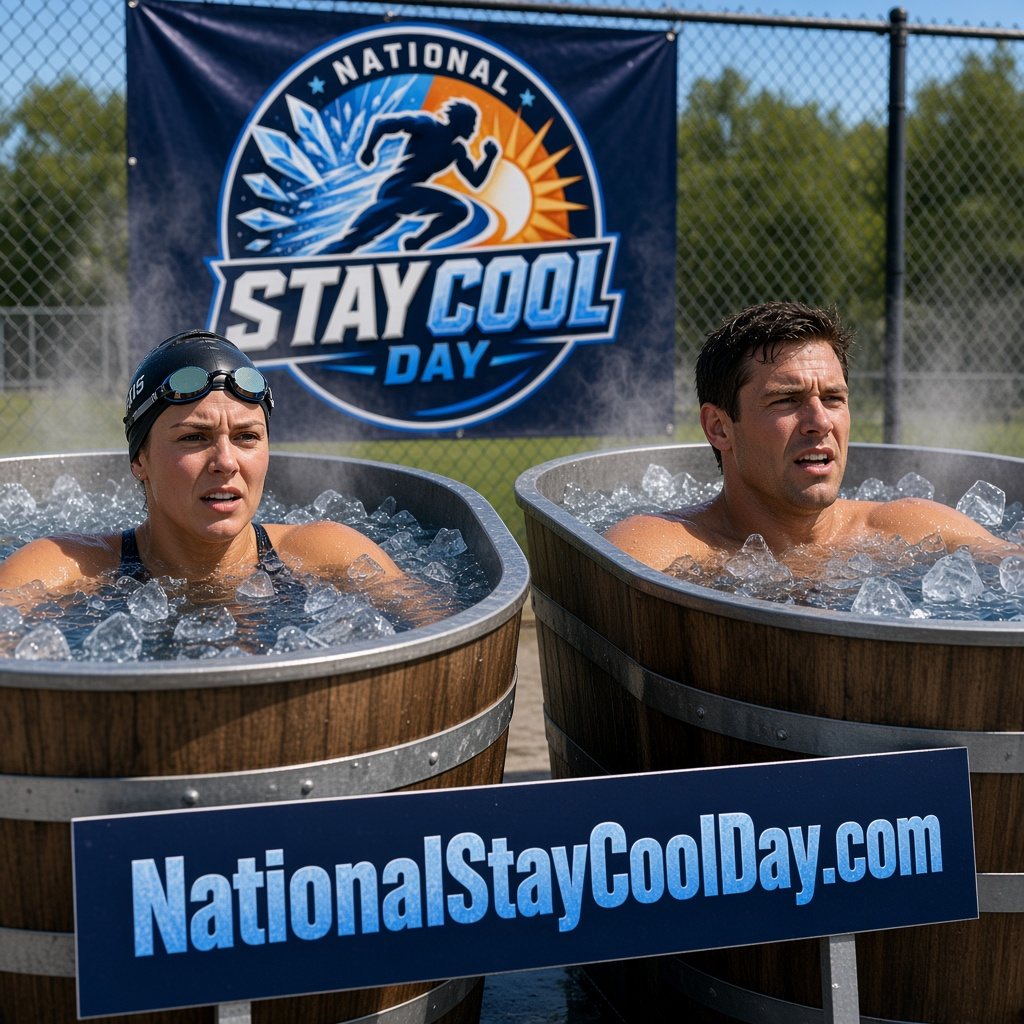
On Thursday, April 8, 2027, schools across the country will hold a heat-safety day. At participating sites with athletic trainer coverage, athletes will step into ice tubs up to the neck for three minutes as part of a world record attempt. The current record is 928 people taking an ice bath simultaneously, set in Montevideo, Uruguay, in April 2024.
The tub is the hook. The lesson is what happens around it.
It is hard to forget watching a teammate climb into a stock tank full of ice water while someone explains why that tank needs to be on the sideline before practice starts. The record attempt gets people to show up. The lesson is why they came.
What the tub demonstrates
A recreational ice bath does not prevent heat stroke, and National Stay Cool Day has never claimed otherwise. The tub on April 8 demonstrates cold-water immersion: the emergency treatment for exertional heat stroke, recommended by the Society of Critical Care Medicine in its 2025 guidelines as the fastest-cooling method that “should be prioritized where available.”
People watching athletes get into that tub are seeing what the response to heat stroke looks like. That image is the lesson. Prevention comes from heat rules, acclimatization, rest, and a written plan, and the free tools on nationalstaycoolday.com cover all of those too.
What the lesson covers
Every participant leaves knowing three things:
- The signs. Confusion, strange behavior, stumbling or collapse, hot skin (sweaty or dry), a racing heartbeat. An athlete can be soaked in sweat and still be in heat stroke.
- The response. Cool first, call 911. Start whole-body cold-water immersion on the spot, call 911 while cooling begins, then hand off to EMS.
- The plan. Where the tub is, who fills it, who checks the temperature, who makes the call, and who backs each of them up.
This is the same model used at college football tailgates, where impaired-driving simulators let fans feel what a drunk-driving crash would take from them. The simulator is not the point. The decision they make later that night is. National Stay Cool Day borrows that model and scales it nationally, run from the ground up by schools, coaches, athletic trainers, and parents in their own towns.
Think heat and heart, together
The field has come a long way. The science of cooling is settled, heat-safety regulations have expanded, and athletic trainers cover more sidelines every year. That progress belongs to many people.
One habit of thinking still needs to change. When an athlete collapses, the instinct is to think of the heart first. On a hot day, even one that only reaches a caution level on the heat index, heat stroke belongs in that first thought too. If no one thinks of heat, no one starts cooling. The athlete is transported while their body temperature keeps climbing.
Two scenarios. Two responses. Both matter.
| Situation | Response |
|---|---|
| Unresponsive, not breathing normally | Call 911. Start CPR. Use an AED as soon as one is available. Nothing in a heat plan delays CPR. |
| Breathing, but collapsed, confused, or acting strangely in the heat | Suspect exertional heat stroke. Cool first, call 911. Start cold-water immersion up to the neck immediately and keep cooling while help is on the way. |
This follows published guidance. The 2024 American Heart Association and American Red Cross first aid guidelines identify whole-body cold-water immersion as a reasonable immediate step for heatstroke with altered mental status. A 2024 pre-hospital consensus statement from the Faculty of Pre-Hospital Care states that cooling must not be delayed when heat stroke is suspected, and that rapid cooling comes before transfer.
Your athletic trainer and team physician set the medical steps for your school. The Emergency Action Plan Builder on nationalstaycoolday.com keeps both cardiac and heat protocols in one plan, with an optional Medical Timeout Card for reviewing AED locations before each contest.
The whole sideline matters
Football is where most documented heat stroke deaths in school sports have occurred, and among football players, linemen on both sides of the ball have been affected most. But heat stroke does not stop at the roster.
The band. The dance line. The cheerleaders. The umpires and referees. Everyone working hard on or around a field on a hot day can overheat. A heat plan that only covers the football team is an incomplete plan.
Every emergency action plan built on nationalstaycoolday.com is designed to cover every person at the venue, not just the athletes on the starting lineup.
Before, during, and after April 8
National Stay Cool Day is not a one-day event with a year of silence on either side. The day is a visible anchor for work that happens before it, during it, and long after it.
Before: building a prepared sideline
A prepared sideline means the tub is already there and filled, the plan is written down, and everyone knows their role before the first whistle. Schools start with three free tools on nationalstaycoolday.com, each designed to be completed in a browser with no account required and nothing stored on our servers.
Emergency Action Plan Builder. Built specifically so schools can plan for more than one athlete down at once. The “More than one athlete down” section covers how many tubs and tarps are at the venue, where the backups are stored, and who cools each athlete if two or three collapse simultaneously. The full builder walks through venues, activities, personnel and backups, equipment, heat rules, and cooling steps. Download a completed plan with your school’s name on every page, ready to post and rehearse.
Heat Rules Card. Select your state and venue, enter your five heat-level thresholds from your state association’s chart, and print a one-page card to post where practice decisions get made.
14-Day Acclimatization Schedule. Enter your sport and first practice date to generate a dated, day-by-day plan for the first 14 days of the season, based on published guidelines for secondary school athletics, with space for your athletic trainer and administrator to sign off.
Each participating school names one campus coordinator, typically the athletic trainer, and receives free kits, posters, checklists, and event instructions.
During: the lesson people can see
On April 8 at 2:00 PM Eastern, the cool-first demonstration runs simultaneously at participating schools. Athletes enter the tubs. Staff and students see what the response to heat stroke looks like in real time. Elementary schools teach the same core lesson in the classroom and in P.E. through “Spot It, Say It, Cool It,” with no ice tubs at that level.
After: tools that stay with the school
The documents a school builds stay with the school. The emergency action plan is posted at each venue, shared with local EMS, and rehearsed, with an annual review and sign-off built in. The Heat Rules Card stays posted. The acclimatization schedule comes back out each season. Free articles for coaches, parents, and teachers remain on nationalstaycoolday.com year-round: a heat stroke symptoms guide, a WBGT action guide for coaches, a heat illness prevention checklist, and coloring pages for elementary classrooms.
The day is April 8. The work is every day.
Why teach kids, not just coaches?
Because kids remember what they practice.
Stop, drop, and roll works because children learn it early, say it out loud, and act it out. Nobody expects a seven-year-old to fight a fire. Only to know the first move. Every national safety habit started small. Heat stroke is the same.
Elementary schools get a classroom and P.E. day built around “Spot It, Say It, Cool It,” with a one-page guide for P.E., nurse, and recess staff, and a take-home family page. No ice tubs at that level. Kids learn to spot the signs, tell a grown-up, and know that the grown-ups cool first and call 911.
The goal is a generation that grows up knowing the first move the way they know stop, drop, and roll. That is not a one-day outcome. It is a long-term one, and it starts in elementary school.
How we measure whether it works
There is no published research testing an ice-bath event as a heat-safety teaching tool. National Stay Cool Day will not claim the day changes behavior until it can show that it does.
What matters is whether people know what to do afterward, not how many showed up or how many times the video was watched. The World Health Organization’s 2026 manual on heat-related illness at mass gatherings makes a related point: messages should be clear, consistent, and built for early action and on-site preparedness.
The knowledge check plan for April 8:
Participants take a short knowledge check once before the day’s lesson and once after. Questions include:
- Name three warning signs of exertional heat stroke.
- An athlete is confused and collapses at practice on a hot day. What do you do first?
- Where is your school’s cooling tub, and who is in charge of it?
The results will be shared publicly. If the day does not teach people the signs and the first move, the lesson will change. That commitment to honest measurement is part of what makes this a movement, not a marketing campaign.
In memory of Eric
National Stay Cool Day carries on the work of Eric, who lived by one belief: no athlete, in any sport and at any age, should suffer a heat injury that could have been prevented.
Eric died in 2026. The people who loved him promised his mission would not end with him.
The science is settled. The work is the implementation: a ready tub, a written plan, and trained people on every field, in every gym, at every school. That work continues every season, not just on April 8, until cool first, transport second is as automatic as stop, drop, and roll.
Cool first. Cool first. Cool first.
Stay Cool. Stay in the Game.
Frequently asked questions
What is National Stay Cool Day?
A free national heat-safety day on Thursday, April 8, 2027. Schools teach the warning signs of exertional heat stroke, the response (cool first, call 911), and their emergency action plan. At sites with athletic trainer coverage, athletes take a three-minute ice bath up to the neck as part of a simultaneous world record attempt.
What gap does National Stay Cool Day close?
The treatment for exertional heat stroke is known. The gap is getting a ready tub, a written plan, and trained people to every sideline. National Stay Cool Day works on that gap with free planning tools, a visible cool-first demonstration on April 8, and year-round resources.
Does National Stay Cool Day claim ice baths prevent heat stroke?
No. The tub demonstrates cold-water immersion, the emergency treatment for exertional heat stroke. Prevention comes from heat rules, acclimatization, rest, and a written plan.
What is the record to beat?
928 people taking an ice bath simultaneously, set in Montevideo, Uruguay, in April 2024.
How much does it cost a school to participate?
Nothing. There is no fee, no contract, and nothing to buy. An optional fundraiser sends 100% of its profit back to the school for cooling and safety equipment.
Is heat safety only a football problem?
No. Football is where most heat stroke deaths in school sports have been documented, with linemen affected most, but the band, dance line, cheerleaders, umpires, and refs can overheat too. Every plan should cover everyone on and around the field.
Do elementary students get in ice tubs?
No. Elementary schools hold a classroom and P.E. day built around the “Spot It, Say It, Cool It” activity. There are no ice tubs at that level.
Who supervises the ice baths?
A certified athletic trainer supervises every site. No site runs without one. Each school’s existing waivers and medical protocols apply, with a signed event waiver, pre-participation screening, a hard three-minute limit, a buddy system, a warm recovery area, and the freedom to exit at any moment.
Do the free tools replace our athletic trainer or team physician?
No. They are planning and education templates. Your athletic trainer and team physician review and approve the medical steps. The heat readings on the Heat Rules Card are left blank on purpose, because rules differ by state. You fill them in from your state association’s chart and confirm them with your medical team.
If an athlete collapses on a hot day, is it the heart or heat?
Think heat and heart. If the athlete is unresponsive and not breathing normally, call 911, start CPR, and use an AED. If they are breathing but collapsed, confused, or acting strangely in the heat, suspect exertional heat stroke: cool first, call 911.
What should I do if I think an athlete has heat stroke?
Cool first, call 911. Start whole-body cold-water immersion right away, call 911 while cooling begins, and keep cooling until EMS takes over.
Is this a one-time event?
No. The people behind National Stay Cool Day are not stopping until “cool first, transport second” and emergency action plans for multiple athletes down are in the hands of every school and every youth program in the country. April 8, 2027 is the beginning.
Sources
- Society of Critical Care Medicine. Guidelines for the Treatment of Heat Stroke. Critical Care Medicine, 2025;53(2):e490-e500.
- American Heart Association and American Red Cross. 2024 Guidelines for First Aid. Circulation, 2024.
- American Red Cross. Exertional Hyperthermia/Heat Stroke, first aid steps.
- American Red Cross. How to Perform CPR: Adult CPR Steps.
- Faculty of Pre-Hospital Care (Royal College of Surgeons of Edinburgh). Consensus Statement on the Pre-Hospital Management of Exertional Heat Illness, November 2024.
- National Center for Catastrophic Sport Injury Research (UNC). Annual Survey of Football Injury Research, 2025 data (published 2026).
- Boden BP et al. Nontraumatic Exertional Fatalities in Football Players, Part 2: Excess in Conditioning Kills. Orthopaedic Journal of Sports Medicine, 2020.
- Grundstein AJ et al. A retrospective analysis of American football hyperthermia deaths in the United States. International Journal of Biometeorology, 2012.
- World Health Organization. Prevention and management of heat-related illness at mass gatherings: developing evidence-based communication messages. September 30, 2026.
This article is for education and preparedness only. It is not a substitute for professional medical advice. In an emergency, cool first, call 911.