October 21, 2026
Cool First. Transport Second. The Two Words That Decide If an Athlete Survives Heat Stroke
Every coach who has ever stood on a sideline in July has felt it: the instinct, when a player goes down hard in the heat, to get them to a hospital as fast as possible. Load them up. Drive. Get help.
That instinct is wrong. And it has cost lives.
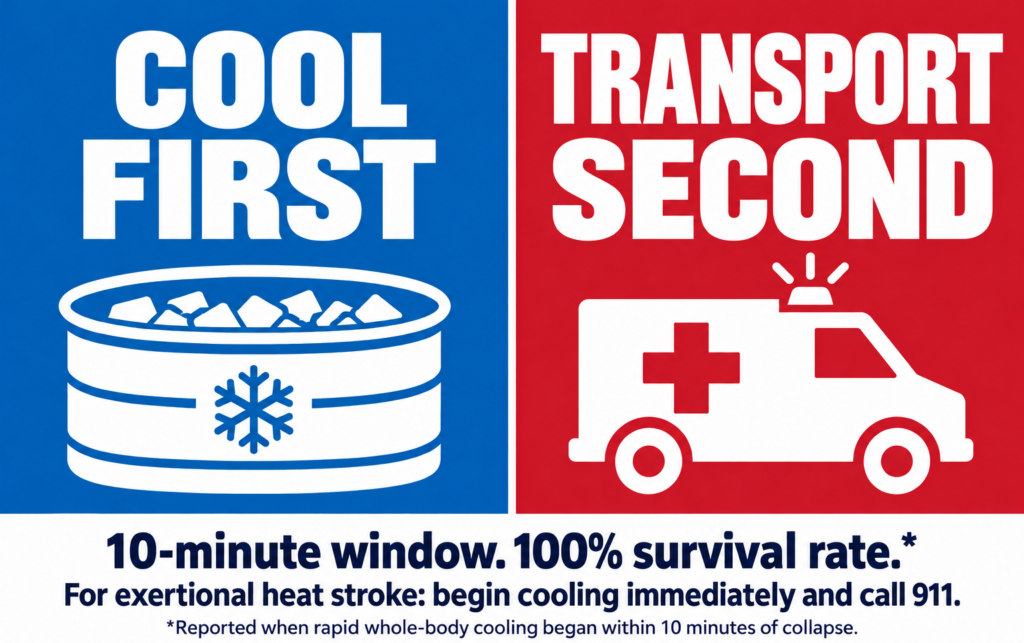
The science on exertional heat stroke is unambiguous, and it comes down to four words: Cool first. Transport second. Not simultaneously. Not “start cooling on the way.” First cool, then transport. The order is the protocol, and the protocol is what separates a survivable event from a fatal one.
This article is not written for athletic trainers. They have their own clinical resources. This is written for the volunteer coach running a travel ball practice in August, the rec league coordinator with 40 kids and no medical staff, the parent who is the most responsible adult on the field when a player collapses. You are the person this protocol was built for — because you are often the only person standing between an athlete and permanent harm.
The single most important thing you can take from this page: If an athlete collapses in the heat and shows signs of confusion, disorientation, or altered behavior, begin cooling immediately. Do not wait for EMS. Do not drive to the hospital first. Cool first. Then call 911.
Download the free Emergency Cooling Card and the Know the Signs card — printable, laminate-ready, built for a clipboard or a coach’s bag. Take them with you before the next practice.
What Exertional Heat Stroke Actually Is
Exertional heat stroke (EHS) is not the same as heat exhaustion, and the difference matters enormously in the first 60 seconds after a player goes down.
Heat exhaustion is serious but not immediately life-threatening. An athlete may feel dizzy, nauseated, weak, or faint. Their skin is often pale and sweaty. They need to be moved to shade, given fluids, and monitored closely. They do not need ice water immersion.
Exertional heat stroke is a medical emergency. The body’s core temperature has exceeded 105°F and the brain is being affected. The defining sign is not temperature — it is central nervous system dysfunction.
The one sign that changes everything
Look for any change in mental status:
- Confusion or disorientation (“Where am I? What happened?”)
- Unusual aggression or irritability
- Slurred speech
- Stumbling or inability to walk normally
- Loss of consciousness or collapse
Do not be reassured by sweating. This is the most dangerous misconception in youth sports heat safety. An athlete who is still sweating can still be in heat stroke. Sweating does not rule it out. The defining factor is what is happening in their brain, not on their skin.
When you see any of those signs in the heat, treat it as heat stroke until proven otherwise. The cost of acting when it turns out to be exhaustion is minimal. The cost of waiting when it turns out to be heat stroke can be permanent organ damage or death.
According to the CDC’s guidance on heat-related illness, exertional heat stroke is the third leading cause of death among high school athletes in the United States — and it is entirely preventable.
Why Cool First. Transport Second. — Not the Other Way Around
This is the question every coach asks when they first hear the protocol: “Shouldn’t I get them to a hospital as fast as possible?”
The answer is no — and the reason is physiological, not philosophical.
When core body temperature exceeds 105°F, every minute without aggressive cooling increases the damage to the brain, kidneys, liver, and heart. The body cannot cool itself fast enough on its own. The hospital is 10, 15, maybe 20 minutes away. By the time an athlete arrives in the emergency room, the window for preventing permanent damage may already be closed.
Cold water immersion is faster than any ambulance.
Research consistently shows that cold water immersion drops core temperature at roughly 1°F every 3 minutes. No other field intervention comes close. Start cooling within 10 minutes and reach 102°F within 30.
The treatment works — when it is used immediately.
The 10-minute window
| Time from collapse | What is happening |
|---|---|
| 0–3 minutes | Core temp still rising. Begin cooling immediately. |
| 3–7 minutes | Every minute of delay raises risk of organ damage. |
| 7–10 minutes | Critical window. Cooling must begin now. |
| After 10 minutes | Risk of permanent harm rises sharply. |
The hospital cannot give an athlete back those minutes. You can.
Why transport first fails
When a coach loads an athlete into a car or waits for an ambulance before cooling begins:
- Core temperature continues to rise during transport
- The athlete arrives at the hospital already past the critical window
- Emergency staff face a harder, slower recovery with worse outcomes
- The ambulance ride itself provides no meaningful cooling
The hospital is the right destination. It is not the right first step.
Call 911 while cooling starts. Give the dispatcher your location. Then stay with the athlete and keep cooling. EMS will arrive and take over. Your job is to close the gap between collapse and the start of treatment — because that gap is where lives are lost.
There are at least 175 documented exertional heat stroke deaths in the United States. In nearly every case, the science to save them already existed. What was missing was a cooling tub on the sideline, a coach who knew the protocol, and the confidence to act.
What to Do When You Have No Ice Tub
This is the most common question from coaches in rec leagues and travel ball: “We don’t have a tub. What do we do?”
The honest answer has two parts.
First: Cold water immersion is the gold standard. If there is any way to have a tub on your sideline — a stock tank from a farm supply store costs under $30, and a bag of ice from a gas station costs a few dollars — that is the setup that saves lives. It does not need to be medical equipment. It needs to be cold water and a container large enough for a person to sit in up to the neck.
Second: If you have no tub, you still act. Any cooling is better than no cooling while you wait for EMS.
If you have no immersion tub, do this in order:
- Move the athlete to shade immediately. Get them out of direct sun and off hot turf.
- Remove equipment and excess clothing. Helmets, pads, jerseys — everything that traps heat.
- Apply ice bags or cold wet towels to the neck, armpits, and groin. These areas have major blood vessels close to the surface and cool the blood faster.
- Fan them aggressively while applying cold. Moving air accelerates cooling.
- Call 911 immediately. Tell the dispatcher you suspect heat stroke and that you are cooling on site.
- Do not give fluids to an athlete who is confused or unconscious. They cannot swallow safely.
Key point: This improvised approach is significantly less effective than cold water immersion. It is not a substitute — it is a bridge. The goal is to start cooling immediately and keep cooling until EMS arrives with better equipment.
The American College of Sports Medicine and major sports medicine bodies are clear: cold water immersion is the field treatment they recommend for exertional heat stroke. Every other method is a backup.
If you coach or run a program without a tub on the sideline, building a plan to have one is the single highest-impact safety decision you can make. The free EAP Builder at National Stay Cool Day walks you through exactly what equipment your program needs and where it should be staged before the first practice.
The Last-Mile Problem: Why Volunteer Coaches Are the Most Important Link
High school programs with full-time athletic trainers have improved their heat stroke outcomes significantly over the past decade. The protocols work when someone is trained to execute them.
The gap is everywhere else.
Travel ball. Rec leagues. Church leagues. Parks and recreation programs. Summer camps. Youth programs with volunteer coaches who show up because they love the sport and love the kids — not because they have medical training. These are the programs where heat stroke deaths still happen, because the knowledge has not reached the sideline.
This is the last-mile problem. The science is settled. The protocol is simple. What is missing is the person on the field who knows it.
That person is you, if you choose to be.
What “being prepared” actually looks like for a volunteer coach
You do not need a medical degree. You need three things:
| What you need | What it looks like in practice |
|---|---|
| Recognition | Know the signs. Confusion in the heat means act now. Download the Know the Signs card. |
| Equipment | A stock tank, ice, and water staged before practice starts. Not in the car. On the field. |
| A written plan | Who calls 911. Who manages cooling. Who talks to EMS when they arrive. Use the free EAP Builder to build yours in under 10 minutes. |
None of this requires institutional support. A volunteer coach can show up to the next practice with a $30 stock tank, a bag of ice, a printed card, and a plan — and be more prepared than most programs in America.
That is not an exaggeration. According to healthychildren.org, many youth athletic programs still do not have specific guidelines for preventing heat illness. The gap between what the evidence demands and what happens on the sideline is not a knowledge problem at the top of the profession. It is a reach problem. The science has not gotten to enough coaches.
National Stay Cool Day exists to close that gap. Every free tool on this site — the EAP Builder, the Heat Rules Card, the 14-Day Acclimatization Schedule, the printable sideline cards — was built for programs without athletic trainers, because those are the programs that need it most.
Take This With You Before the Next Practice
Heat stroke is survivable. The treatment is cold water. The protocol is four words. The window is 10 minutes.
None of that changes whether you have an athletic trainer on your sideline or not. What changes is whether the person who is there knows what to do.
Before your next practice, do these three things:
- Download the free Emergency Cooling Card. Print it. Laminate it if you can. Clip it to your bag. It has the exact steps: strip, immerse, call 911, monitor.
- Download the Know the Signs card. Share it with every adult on your sideline. One page. The signs that mean act now.
- Build your Emergency Action Plan. The free EAP Builder takes under 10 minutes and produces a finished document with your program’s name on it, ready to post and rehearse.
Cool first. Transport second. Four words. Memorize them. Share them. They are the difference between a tragedy and a story about the coach who knew what to do.
National Stay Cool Day was built in memory of Eric, a lifelong athlete who believed that no athlete, in any sport and at any age, should suffer a preventable heat injury. Every tool on this site is free. No account required. No cost. Because the science should reach every sideline — not just the ones with full-time medical staff.