October 9, 2026
Why Your Emergency Action Plan Must Account for Multiple Athletes Going Down at Once
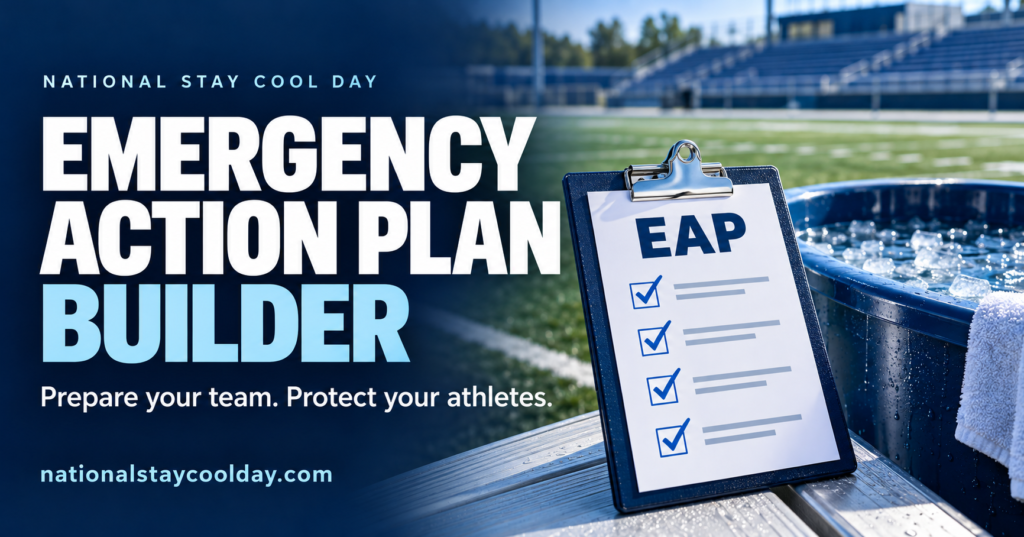
In recent years, coaches and athletic trainers have witnessed something that the standard EAP template was never designed to handle: multiple athletes collapsing from exertional heat stroke (EHS) during the same practice or event. When that happens, a plan built for one patient fractures immediately. Who gets the ice tub first? Who calls 911 when the athletic trainer is already immersed in cooling a critical athlete? Who monitors the second and third casualties while the first is being treated?
The hard truth: Exertional heat stroke is 100% survivable with proper care, according to research published in Current Sports Medicine Reports. The window to act is 30 minutes. A plan that collapses under the weight of two simultaneous casualties turns a survivable emergency into a preventable death.
This article is for coaches and athletic trainers who want to close that gap before it costs a life.
Multiple Casualties Are Not a Rare Edge Case
For years, the conventional wisdom in sports medicine held that heat stroke events were isolated incidents. One athlete, one response, one outcome. The data tells a different story.
Military surveillance data from Fort Benning, Georgia provides the most detailed picture of clustered heat casualties in an organized training environment. Over a five-year period, clusters of 10 or more heat illness casualties occurred on 19 separate days, with the largest single-day cluster reaching 20 casualties across seven different units. Of the 243 total casualties in those cluster events, 32 (13.1%) were diagnosed with heat stroke, not just heat exhaustion. These were life-threatening emergencies happening simultaneously across multiple locations.
Civilian athletics face the same risk pattern. Research on mass-participation endurance events published in peer-reviewed literature documents heat stroke rates as high as 3.7 per 10,000 starters in endurance running, with 78% of cases clustering on the three hottest days of competition. At a triathlon study tracking over 68,000 competitors, 12 athletes were diagnosed with EHS across 11 events, with multiple cases occurring during the same race.
Why Team Sports Are Particularly Vulnerable
In team sports, the risk of simultaneous casualties is structurally higher than in individual sports. Every athlete on a football field, soccer pitch, or track is:
Exercising at similar intensity levels
Exposed to the same ambient temperature and humidity
At the same stage of acclimatization (or lack thereof)
Often wearing similar equipment that traps heat
This shared exposure means that when conditions are dangerous enough to take down one athlete, they are likely dangerous enough to take down several. American football has the highest incidence of heat illness of any team sport, ranging from 0.6 to 41.9 cases per 10,000 athlete-exposures. EHS-related death rates in football are also the highest of any sport, with 47 of 63 EHS-related deaths in football between 1995 and 2017 occurring at the secondary school level. Ninety percent of those deaths happened during practice, not competition.
The preseason window is the highest-risk period. EHI rates during preseason are 9.8 times higher than during the regular season (1.45 vs. 0.15 per 10,000 athlete-exposures). This is exactly when athletes are least acclimatized, coaches are pushing conditioning hardest, and medical resources are often thinnest.
Where Standard EAPs Break Down
The NATA Position Statement on Emergency Action Plan Development is clear: an EAP should not be injury or illness specific, and it must delineate a chain of command with anticipated roles for all available personnel. Most programs read that guidance and build a plan. The problem is that most of those plans implicitly assume a single-patient event.
Here is what a standard EAP response looks like for one EHS casualty:
First responder recognizes EHS (altered mental status, core temp above 104°F)
Athletic trainer initiates cold water immersion (CWI) in the ice tub
A second person calls 911 and directs EMS to the scene
AT monitors rectal temperature until it drops below 102°F (38.9°C)
EMS transports athlete to hospital
This works. Every role is covered. Now add a second athlete going down while the first is still in the tub.
The Multi-Casualty Failure Points
When a second or third athlete collapses simultaneously, most standard EAPs hit three critical failure points:
Failure Point | What Happens | Why It Is Dangerous |
|---|---|---|
Single cooling resource | Only one ice tub is available; second athlete waits | EHS requires core temp below 102°F within 30 minutes of collapse. Every minute of delay increases organ damage risk. |
Undivided AT attention | The AT cannot safely monitor two immersed athletes at once | Continuous rectal temperature monitoring and CNS status checks are required throughout cooling. |
Communication breakdown | The person who called 911 is now managing the scene; nobody has communicated that there are multiple critical patients | EMS may arrive prepared for one patient and be caught off guard by two or three. |
The NATA Inter-Association Task Force on Emergency Health and Safety specifies that the EAP coordinator must delineate a chain of command with roles for all available personnel. In a multi-casualty scenario, that chain of command needs to be pre-assigned, not improvised on the field while two athletes are in crisis.
What a Multi-Casualty Heat EAP Must Include
Building a heat EAP that holds up when multiple athletes go down requires addressing five specific gaps that single-patient plans leave open.
1. Pre-Assigned Roles for Every Scenario
Every person on the sideline, in the training room, or on the coaching staff needs a defined role before an emergency starts. The NATA EAP Position Statement recommends that the EAP coordinator delineate a chain of command with anticipated roles for all available personnel, and that this chain must not rely solely on health care team members.
For a multi-casualty heat event, pre-assigned roles should include:
Primary medical responder: The AT or most qualified person on-site. Manages the most critical patient.
Secondary responder: A trained coach, assistant AT, or team physician who manages the second casualty until additional help arrives.
EMS caller: A designated individual whose only job is to call 911, communicate the number of casualties, and guide EMS to the scene.
Equipment runner: Retrieves additional cooling supplies (ice bags, towels, a second tub if available) immediately upon the second casualty being identified.
Scene controller: Keeps other athletes away from the area, prevents panic, and maintains a clear path for EMS.
These roles must be practiced, not just written down. Run a tabletop drill. Walk through what happens when two athletes collapse within five minutes of each other.
2. Multiple Cooling Resources On-Site
A single ice tub is not enough. The NATA Consensus Statement on Heat Illness is explicit: cold water immersion (CWI) at approximately 35°F to 58°F (1.67°C to 14.5°C) is the gold-standard treatment for EHS. Alternatives, including ice towel rotation, cold water spray with fans, and ice packs over major vessels, are acceptable when immersion is not possible, but they cool significantly more slowly.
Programs should have, at minimum:
One dedicated ice tub per 25 to 30 athletes at high-risk practices (preseason, extreme heat days)
Backup cooling supplies staged and ready: multiple bags of ice, large plastic tarps or kiddie pools that can be converted into emergency cooling stations, and a continuous water source
Ice towels pre-staged in coolers so they are ready for immediate rotation on a second or third casualty
The goal is to begin cooling every EHS athlete within minutes of collapse, not to wait for the first tub to free up.
3. Communication with EMS Before the Season Starts
The NATA Inter-Association Task Force recommends that EAPs be developed in concert with local EMS providers. This is not a formality. It is an operational necessity.
Before preseason begins, contact your local EMS agency and communicate:
The location of your facility and the fastest vehicle access route
That your program uses “cool first, transport second” protocols, so EMS should stand by on-site during cooling rather than loading athletes immediately
The maximum number of athletes on-site during high-risk practices, so EMS can pre-plan for a potential multi-casualty response
When you call 911 during a multi-casualty event, the dispatcher needs to know immediately: “We have multiple athletes with suspected exertional heat stroke. We are cooling on-site. We need multiple units.” That message, delivered clearly, changes the EMS response from a single ambulance to a mass casualty dispatch.
4. Environmental Monitoring as a Trigger
The best multi-casualty plan is the one that prevents the event from happening. The NATA Youth Sports Task Force guidelines recommend using a wet-bulb globe temperature (WBGT) device, heat index chart, or local weather data to assess whether it is safe to exercise before every outdoor practice.
When WBGT or heat index reaches threshold levels, the EAP should automatically trigger heightened protocols:
Increase rest-to-work ratios
Reduce equipment and protective gear
Station a dedicated monitor whose only job is watching athletes for early signs of heat illness
Pre-fill ice tubs before practice begins, not after the first athlete goes down
Critical insight: Multiple simultaneous casualties almost always occur when environmental conditions are at their worst. Having your multi-casualty response resources already staged when the heat index is extreme is the difference between a managed emergency and a chaotic one.
5. A Documented Triage Protocol
When two or more athletes show signs of EHS at the same time, the responding team needs a pre-established triage framework. World Athletics’ Emergency Care guidelines recommend the standard ABCDE primary survey (Airway, Breathing, Circulation, Disability/neurologic status, Exposure) for all casualties, followed by rapid resuscitative measures.
For heat-specific triage in a multi-casualty scenario:
Identify the most critical patient first. An athlete who is unconscious or has no detectable pulse takes priority over one who is confused but responsive.
Begin cooling on all suspected EHS casualties simultaneously using whatever resources are available. An athlete in an ice towel wrap is being cooled. An athlete waiting with no intervention is losing the 30-minute window.
Assign one monitor per athlete once cooling is initiated. Core temperature must be checked continuously via rectal thermometer. Cooling stops when temperature reaches approximately 101°F to 102°F (38.3°C to 38.9°C).
Do not transport until cooled, unless the athlete has a life-threatening airway, breathing, or circulation issue that cannot be managed on-site. The “cool first, transport second” mandate applies to every EHS patient, not just the first one treated.
The Bottom Line for Coaches and Athletic Trainers
The assumption that only one athlete will go down at a time is not a reasonable baseline anymore. It is a planning failure waiting to become a tragedy.
Exertional heat stroke is survivable. Every single case, with the right response. The 30-minute cooling window is not a guideline; it is a biological deadline. When two or three athletes hit that deadline at the same moment, a plan built for one will fail them.
The standard of care is clear: “Cool first, transport second” applies to every EHS patient simultaneously. Your EAP must be built to execute that standard for multiple athletes at once, with pre-assigned roles, staged equipment, and EMS partners who know what to expect.
Audit your current EAP against these five questions:
Does your plan name a secondary responder for a second simultaneous casualty?
Do you have enough cooling resources on-site to begin immersion or aggressive cooling on two athletes at the same time?
Have you contacted your local EMS agency before this season to walk through a multi-casualty heat scenario?
Does your EAP include an environmental trigger that stages resources before the first athlete goes down?
Has your staff practiced a two-casualty drill, not just a one-casualty drill?
If any answer is no, the plan is not finished. Review the NATA Position Statement on EAP Development and the NATA Inter-Association Consensus Statement on Heat Illness as the authoritative frameworks for building a plan that actually holds up when the worst-case scenario stops being hypothetical.
If you need a faster starting point, use the free EAP Builder to draft a plan you can review, customize, and test with your staff before the next hot practice.